You got your blood test back. It shows low hemoglobin, and your doctor says you have anemia. But which type? Because types of anemia are not all the same, the treatment for each one is completely different.
In this guide, we explain the main types of anemia, how doctors identify each one using your blood test, and what the differences mean for you.
Anemia is a condition in which your blood does not have enough healthy red blood cells — or enough hemoglobin — to carry adequate oxygen to your body’s tissues. It is not a single disease. Rather, it is a sign that something else is wrong.
Think of anemia like a warning light on your car dashboard. The light tells you something is wrong — but not whether the tank is empty, the pump is broken, or there is a leak. Each problem has a different fix.
In the same way, a low hemoglobin on your CBC tells your doctor something is wrong — but not what is causing it.
The type of anemia determines the treatment. Getting the type wrong means the treatment will not work.
How Doctors Classify the Types of Anemia
Doctors use two main approaches to classify anemia.
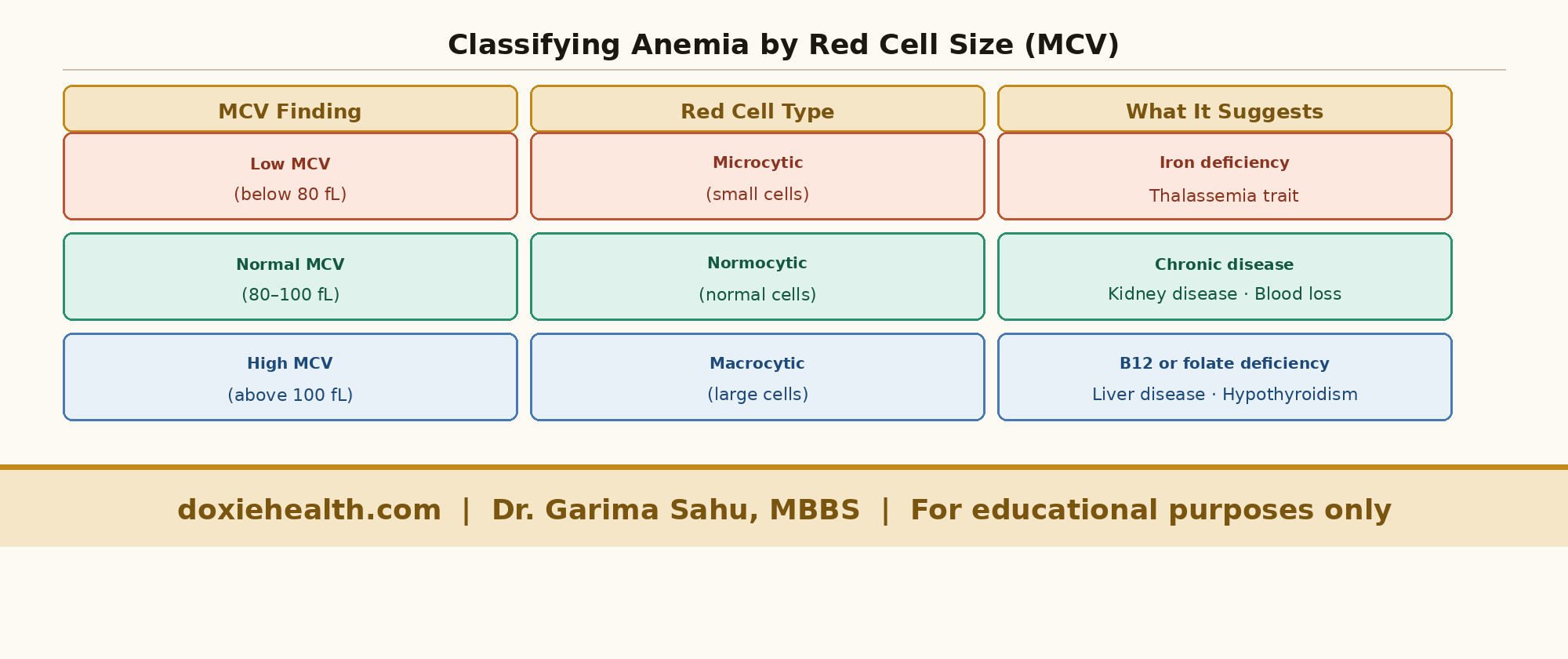
The first is by red cell size (MCV), which your CBC measures directly.
The second is by underlying mechanism — what is actually going wrong in the body.
Both approaches together give a complete picture.
Classifying anemia by red cell size (MCV). Diagram: DoxieHealth
For a full explanation of MCV and CBC markers, see our CBC Blood Test Explained guide on DoxieHealth.
Anemia is not one condition — it is a group of distinct disorders, each with a different cause, blood test pattern, and treatment.
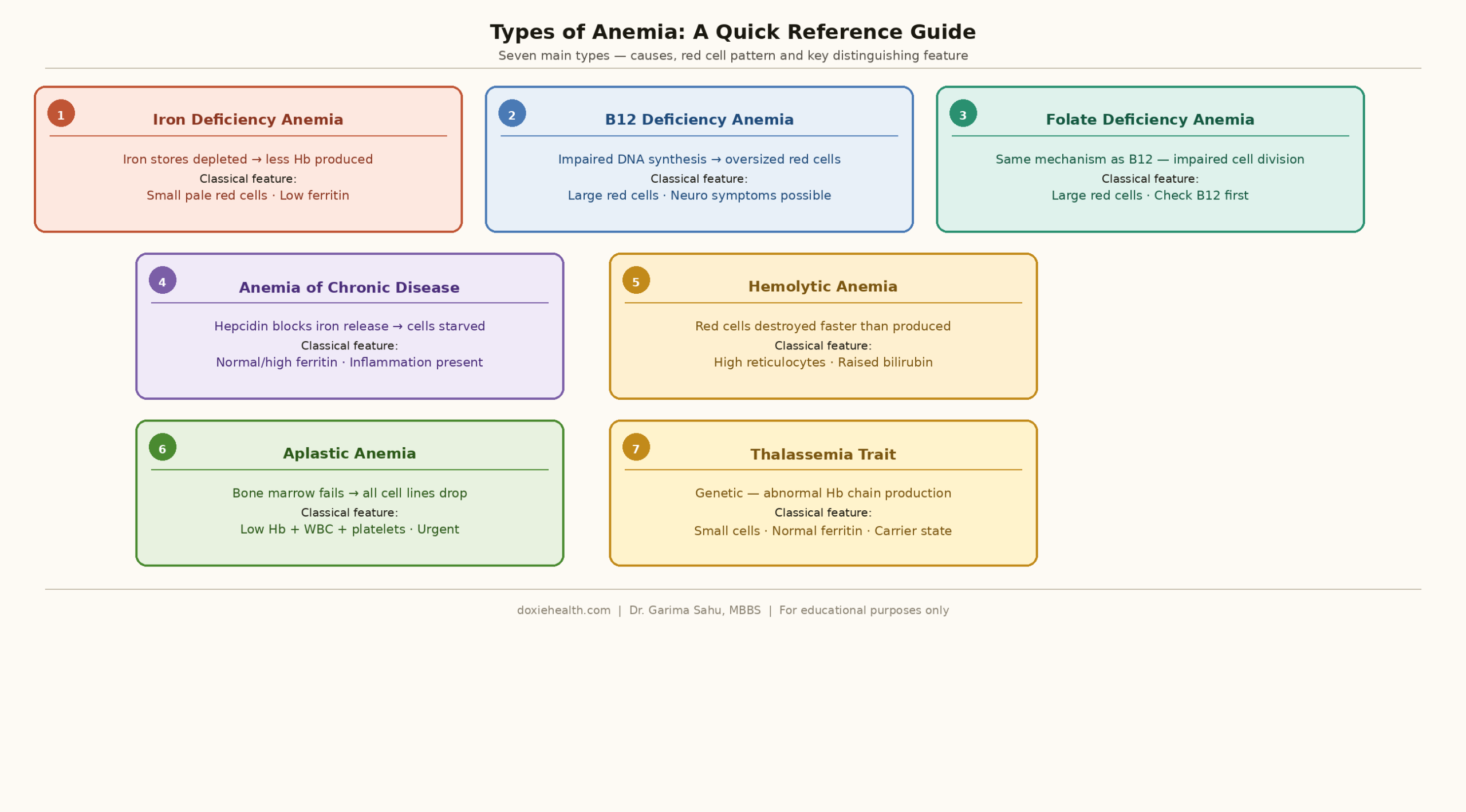
The seven main types are classified by what goes wrong in the body and how red blood cells are affected.
Understanding which type you have is the essential first step before any treatment begins.
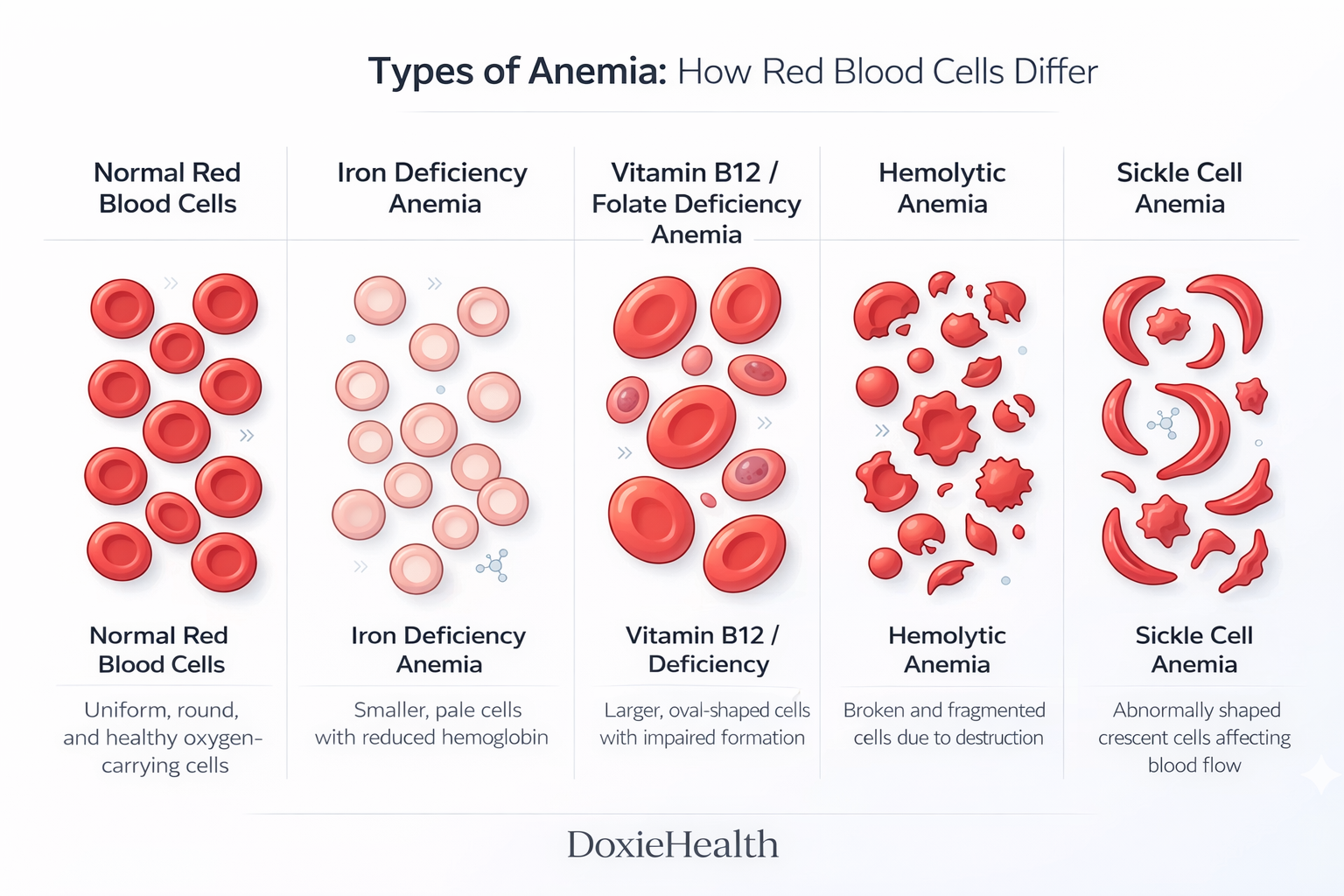
Seven main types of anemia — mechanism and classical features. Diagram: DoxieHealthVisual comparison of how red blood cells change in different types of anemia, helping you quickly understand the underlying differences
1. Iron Deficiency Anemia
Iron deficiency anemia is the most common type worldwide — affecting an estimated 1.2 billion people. It occurs when the body does not have enough iron to produce hemoglobin.
What causes it: Inadequate dietary iron, poor absorption, or chronic blood loss — such as heavy periods, gut bleeding, or frequent blood donation.
What the CBC shows: Low hemoglobin, low MCV (small red cells), low MCH (pale red cells), high RDW (variable cell sizes). Serum ferritin will be low — often the earliest sign, falling before hemoglobin drops.
Who is most affected: Women of reproductive age, pregnant women, vegetarians, and people with gut conditions.
Vitamin B12 is essential for DNA synthesis — the process by which red blood cells are produced in the bone marrow.
Without adequate B12, red cells cannot divide properly and instead grow into abnormally large, immature cells that cannot carry oxygen effectively.
What causes it: Poor dietary intake (strict vegetarians and vegans are at higher risk), pernicious anemia (where the stomach cannot produce intrinsic factor needed to absorb B12), celiac disease, or long-term use of metformin or proton pump inhibitors.
What the CBC shows: High MCV (large red cells), low hemoglobin, low RBC count. A blood smear shows characteristic hypersegmented neutrophils — a hallmark finding. Serum B12 levels will be low.
Important: B12 deficiency also causes neurological symptoms — tingling in the hands and feet, memory problems, and difficulty walking. These can occur even before anemia develops, which is why early detection matters.
3. Folate Deficiency Anemia
Folate (Vitamin B9) deficiency causes anemia through the same mechanism as B12 — impaired DNA synthesis leading to large, abnormal red cells. The two conditions look almost identical on a CBC, which is why both are tested together.
What causes it: Poor dietary intake, alcohol excess, malabsorption conditions, or certain medications such as methotrexate.
What the CBC shows: High MCV, low hemoglobin — indistinguishable from B12 deficiency on CBC alone. Serum folate and B12 levels must both be checked to differentiate them.
Critical point: Never treat folate deficiency with folate supplements alone without first checking B12. Giving folate to someone with an undiagnosed B12 deficiency can correct the blood count but allow neurological damage to progress silently.
4. Anemia of Chronic Disease
This is the second most common type of anemia — yet it is frequently misunderstood. It occurs in people with ongoing inflammatory conditions such as rheumatoid arthritis, inflammatory bowel disease, chronic kidney disease, cancer, or chronic infections.
What causes it: Inflammation triggers the release of a hormone called hepcidin, which blocks iron from being released from storage and reduces red cell production. Iron stores are often normal or elevated — the body simply cannot use them properly.
What the CBC shows: Normal or mildly low MCV, low hemoglobin. Serum ferritin is normal or high — this is the key finding that distinguishes it from iron deficiency anemia, where ferritin is low.
Treatment: Treating the underlying condition is the primary goal. Iron supplements are generally not helpful and can sometimes cause harm.
5. Hemolytic Anemia
Hemolytic anemia occurs when red blood cells are destroyed faster than the bone marrow can replace them. Normally, a red cell lives for about 120 days — in hemolytic anemia, this lifespan is dramatically shortened.
What causes it: Causes are divided into two groups:
Intrinsic — a problem within the red cell itself, such as sickle cell disease, thalassemia, or G6PD deficiency
Extrinsic — something outside the red cell attacking it, such as autoimmune conditions, infections, medications, or mechanical heart valves
What the CBC shows: Normal or low MCV, low hemoglobin, elevated reticulocyte count (immature red cells — the bone marrow working overtime), and raised bilirubin and LDH on a separate panel. A blood smear shows fragmented red cells in some types.
6. Aplastic Anemia
Aplastic anemia is rare but serious. It occurs when the bone marrow fails to produce enough red cells, white cells, and platelets simultaneously.
What causes it: It can be autoimmune (the immune system attacks the bone marrow), triggered by viral infections, certain medications, radiation, or rarely, it is inherited.
What the CBC shows: Low hemoglobin, low white cell count, and low platelets — all three falling together. This combination, called pancytopenia, is a red flag that requires urgent specialist evaluation.
Treatment: Requires specialist haematology care — options include immunosuppressive therapy or bone marrow transplant depending on severity.
7. Thalassemia Trait
Thalassemia is a genetic condition in which the body produces abnormal or insufficient hemoglobin chains. Thalassemia trait (also called thalassemia minor) is the carrier state and is extremely common in South Asian populations, including India.
What causes it: Inherited from one parent. It does not cause significant illness but can be mistaken for iron deficiency anemia because both show small red cells on a CBC.
What the CBC shows: Low MCV, mildly low hemoglobin — looks similar to iron deficiency. However, ferritin is normal, and the RBC count is often normal or even elevated. Hemoglobin electrophoresis or genetic testing confirms the diagnosis.
Why it matters: If two carriers have children together, there is a 25% chance of the child inheriting thalassemia major — a severe condition requiring lifelong transfusions. Genetic counselling is recommended for couples who are both carriers.
How Doctors Tell the Types of Anemia Apart — Pattern Recognition
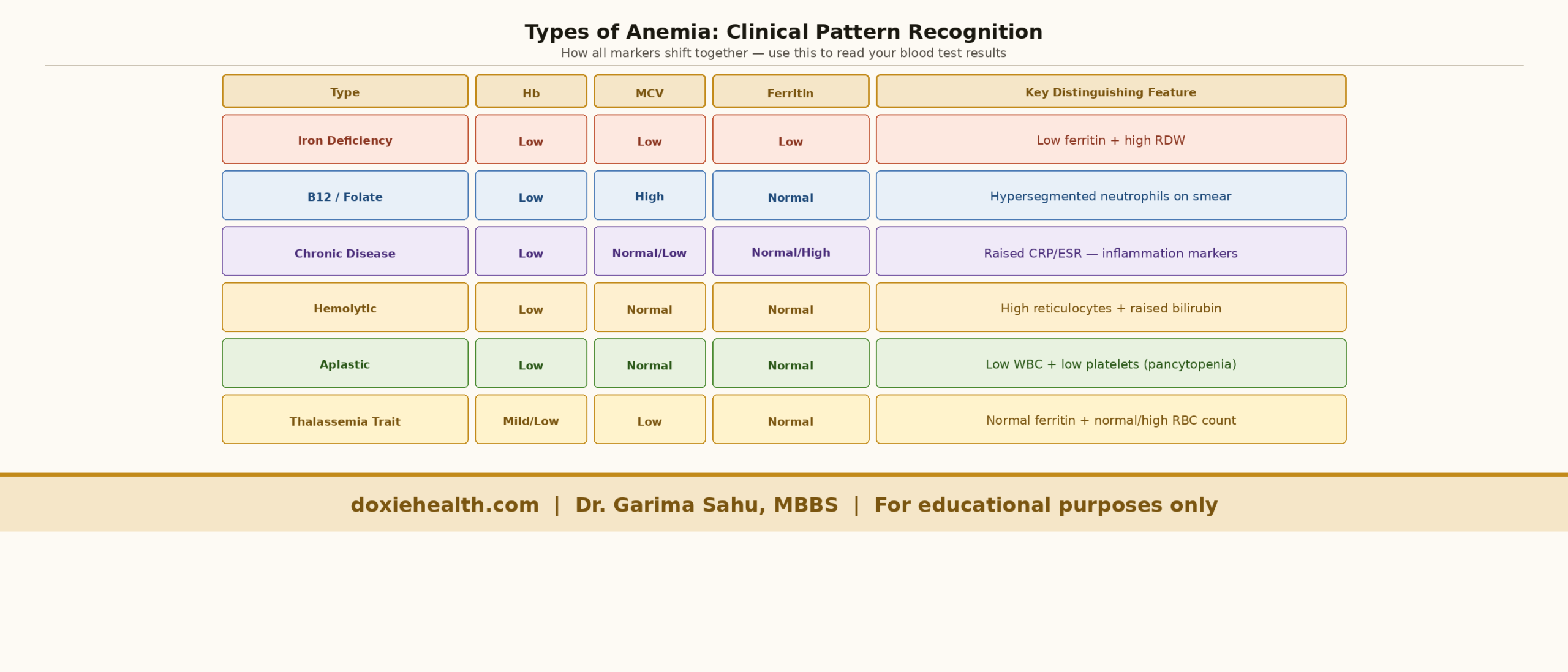
No single marker tells the complete story. Doctors always read these results as a pattern:
How CBC markers shift in each type of anemia — clinical pattern recognition. Diagram: DoxieHealth
Key Clinical Insights
Never treat anemia without identifying the type — giving iron supplements to someone with B12 deficiency, thalassemia trait, or anemia of chronic disease will not help and may delay correct treatment
Ferritin is the most important distinguishing marker — it separates iron deficiency (low ferritin) from anemia of chronic disease (normal/high ferritin) when both show similar CBC patterns
Thalassemia trait is commonly mistaken for iron deficiency in India — the distinguishing feature is a normal ferritin alongside a low MCV. Always check ferritin before starting iron supplements
B12 deficiency neurological symptoms can precede anemia — do not wait for hemoglobin to drop before checking B12 in someone with tingling, memory issues, or fatigue
Pancytopenia — all three cell lines low — low Hb + low WBC + low platelets together always requires urgent investigation. Do not attribute this to diet alone
👩⚕️ Doctor’s Note • Anemia is one of the most common findings on a blood test — and one of the most commonly mismanaged. • The single most important step is identifying the type before starting any treatment. • A low hemoglobin with a low ferritin points clearly to iron deficiency. • A low hemoglobin with a normal ferritin needs further investigation. • Always bring your full blood test report — including MCV, ferritin, and B12 to your appointment, not just the hemoglobin value alone.
Family history of thalassemia — get screened before planning a pregnancy
Anemia in a man or post-menopausal woman always requires investigation for an underlying cause
The Takeaway
Types of anemia differ significantly in their causes, their blood test patterns, and their treatments. Understanding which type you have is the essential first step.
Your CBC is the starting point, but ferritin, B12, folate, and sometimes a blood smear are needed to complete the picture.
Walk into your appointment knowing your full results — not just your hemoglobin.
Questions to Ask Your Doctor
“Which type of anemia do I have — and how was it identified?” — the type should always be confirmed before treatment begins
“Has my ferritin been checked alongside my hemoglobin?” — essential to differentiate iron deficiency from other types
“Should my B12 and folate be tested as well?” — especially if MCV is high or normal with no clear cause
“Could this be thalassemia trait rather than iron deficiency?” — important if MCV is low but ferritin is normal
“Do I need a blood smear or any further tests?” — Some types require specialist tests beyond a basic CBC
“Should my family members be tested?” — relevant for thalassemia and inherited hemolytic anemias
References & Further Reading
Kasper DL et al. Harrison’s Principles of Internal Medicine, 21st ed. McGraw-Hill, 2022.
Medical Disclaimer: This article is for educational purposes only and does not constitute medical advice, diagnosis, or treatment. Always consult a qualified healthcare professional for guidance about your specific health situation.
WRITTEN & MEDICALLY REVIEWED BY
Dr. Garima Sahu, MBBS
Physician & Founder, DoxieHealth
This article is for educational purposes only and does not replace professional medical advice
Wow, as a non medico I thought all anemia meant was low iron in blood and that I had to eat spinach to recover. There is so much more nuance to it than meets the eye. Thanks DoxieHealth for clearing up this topic.




Leave a Reply