Your doctor said the words. Maybe it was at a routine check-up, maybe after a blood test that came back unexpectedly high. Either way, you walked out of that clinic wondering how to manage Type 2 diabetes and feeling that everything just got a lot more complicated.
You’ve probably been told to eat less sugar, exercise more, take your medication. You’re trying. But the HbA1c isn’t coming down the way it should. Or you genuinely don’t know where to start, and every piece of advice you’ve found contradicts the last thing you read.
This article puts it all together: a clear picture of your food, your habits, and why certain things are silently making things worse. Follow what’s here consistently, and your numbers will move.
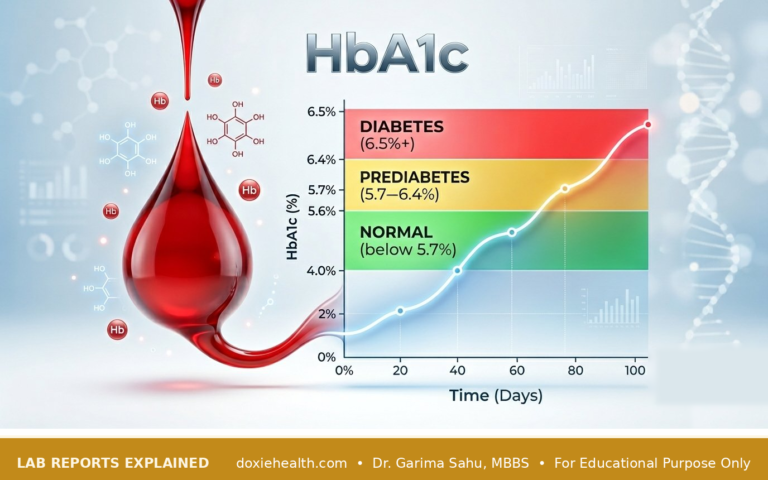
The target is specific. Bring your HbA1c below 7%, ideally closer to 6.5%. Keep fasting blood sugar between 70–100 mg/dL. Keep your two-hour post-meal sugar below 140 mg/dL.
Four things get you there: what you eat, when you eat, how you move, and in most cases, the right medication. All four matter. None works as well alone.
→ Want to understand what Type 2 diabetes is and how it develops? Read our full guide to diabetes types, causes, and complications.
Managing Type 2 diabetes comes down to three things working together:
🥗 Diet – what you eat, how much, and when. The most powerful lever you have.
🏃 Lifestyle – how you move, sleep, manage stress, and structure your day.
💊 Medical management – the medications and monitoring that support everything else.
All three matter. But most people are handed a prescription and sent home without a clear picture of what to actually eat, which is where blood sugar (Blood Glucose) control is either won or lost, meal by meal.
This article focuses entirely on diet; the most impactful and often the most misunderstood aspect of managing Type 2 diabetes in Indian households.
Now that you know how to build a diabetes-friendly plate, now it’s time to bring all these pieces together. In Part 2, learn the other factors that can significantly improve your blood sugar control: [Lifestyle & Medical Management for Type 2 Diabetes.] Upcoming
Diet: Your Most Powerful Tool
This is where most Indian diabetes patients both struggle the most and stand to gain the most. Let’s go through it step by step, not as a list of things you cannot have, but as a clear framework that actually works.
First: What Is Glycaemic Index And Why Does It Matter?
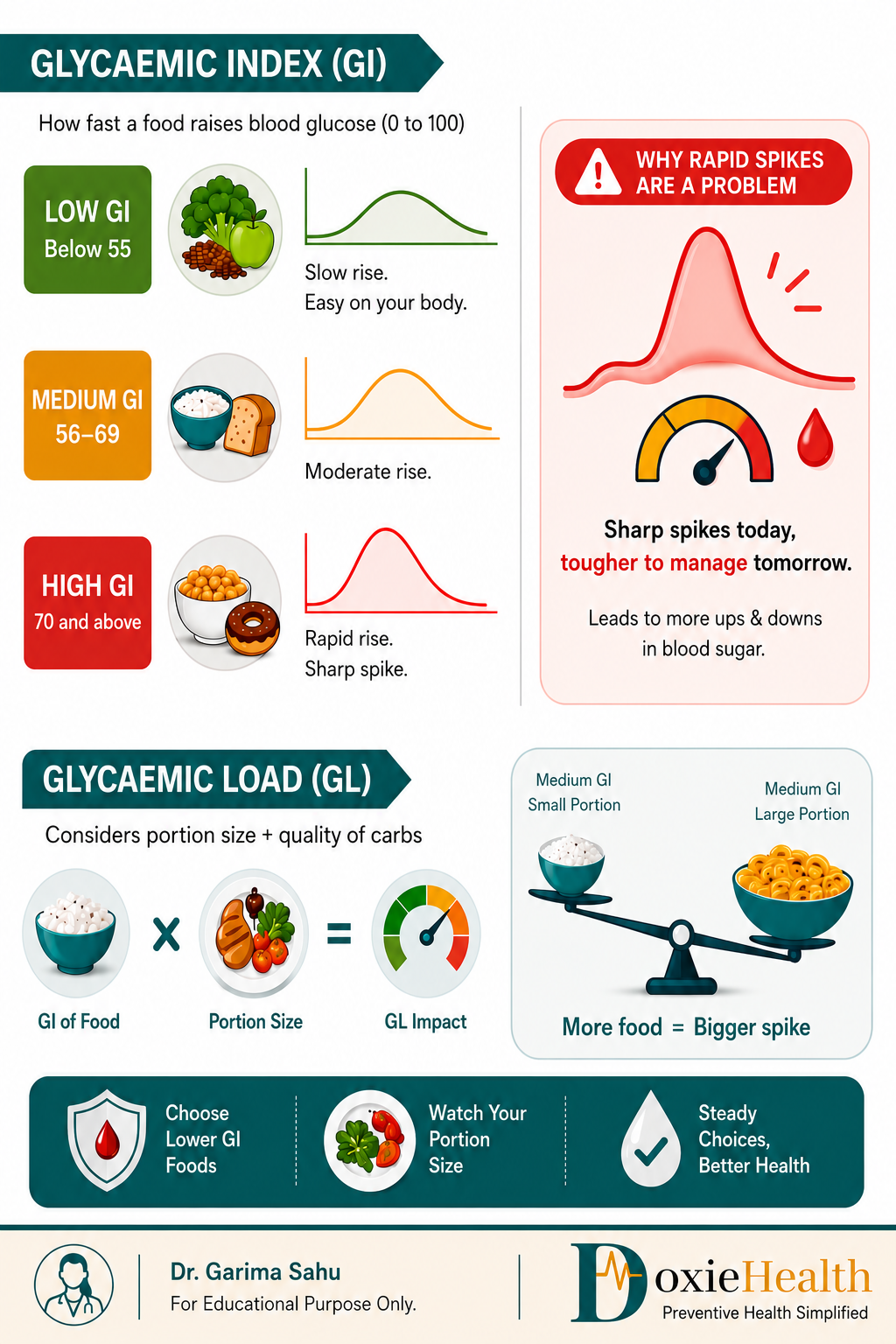
Understanding GI and GL is the first step to making smarter food choices for blood sugar control. | Image: DoxieHealth
Not all carbohydrates are equal. Some are digested quickly and flood the bloodstream with glucose (Sugar). Others break down slowly, giving the body time to respond.
Glycaemic Index (GI) measures exactly this: how fast a food raises blood glucose after eating, on a scale of 0 to 100. Foods that cause a slower rise in blood sugar are generally easier for your body to manage than foods that cause sharp spikes.
Low GI (below 55): Slow absorption. Gradual, manageable rise in blood sugar.
Medium GI (56–69): Moderate rise.
High GI (70 and above): Rapid absorption. Sharp spike.
Glycaemic Load (GL) goes one step further: it accounts for portion size. A medium-GI food eaten in a large amount still causes a big spike. This is why how much you eat matters alongside what you eat.
Why the Typical Indian Diet Works Against You
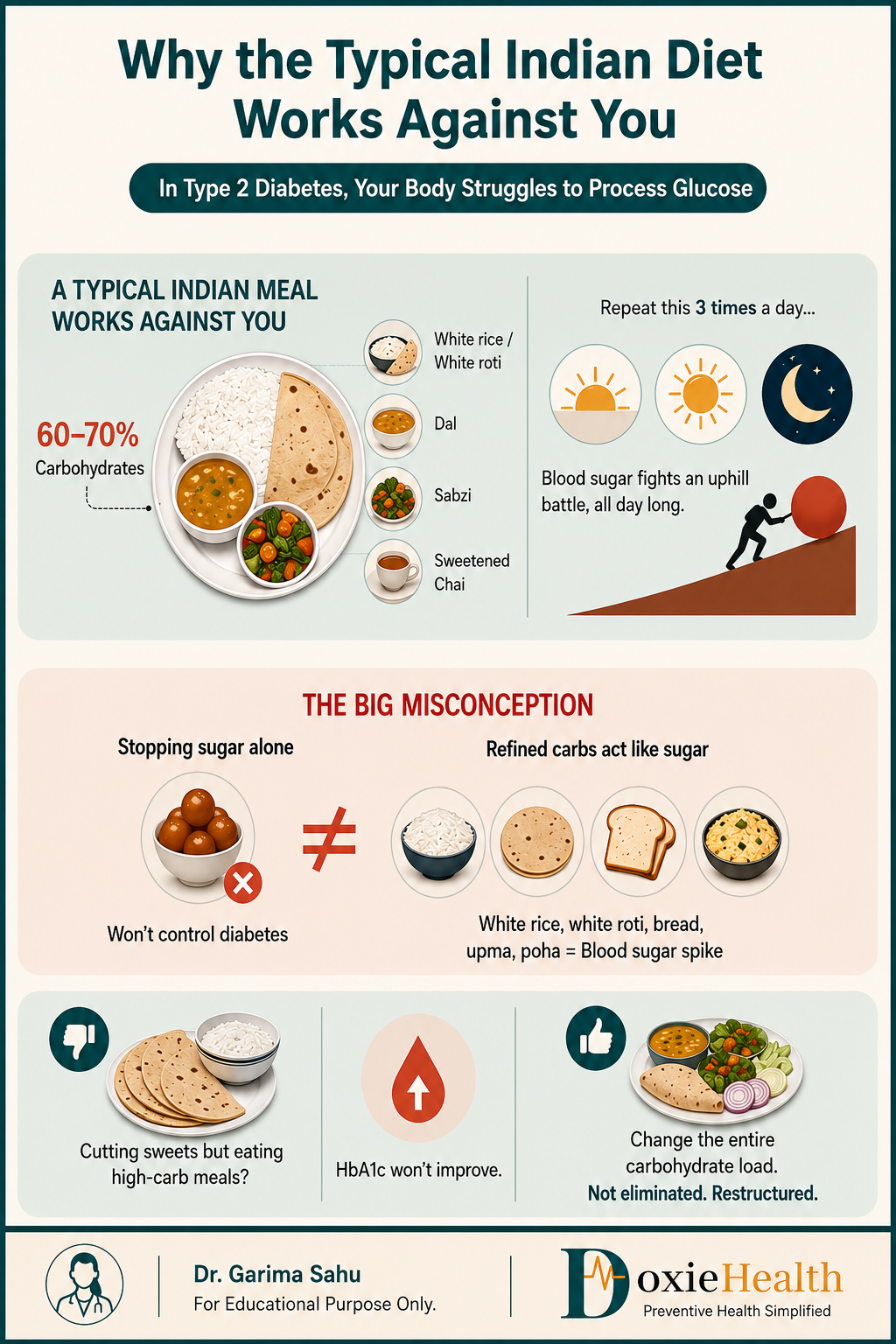
The typical Indian meal is 60–70% carbohydrates. Cutting sweets alone won’t move your HbA1c — the entire carbohydrate load needs to change. | Image: DoxieHealth
In Type 2 diabetes, the body cannot process glucose efficiently. Every carbohydrate you eat breaks down into glucose and enters the bloodstream. The more carbohydrates you eat, and the faster they are absorbed, the higher your blood sugar rises.
A typical Indian meal puts carbohydrates at 60–70% of the plate: white rice or white roti as the base, dal and sabzi as sides, sweetened chai in between. Repeat this three times a day and blood sugar is fighting an uphill battle around the clock.
Here is the most important thing most people are never told clearly: stopping sugar alone will not control diabetes. White rice, white roti, bread, upma, poha: these are all refined carbohydrates that behave much like sugar in the bloodstream. Cutting out mithai while eating four rotis and a plate of rice three times a day will not bring your HbA1c down.
The entire carbohydrate load of your diet needs to change. Not eliminated: restructured.
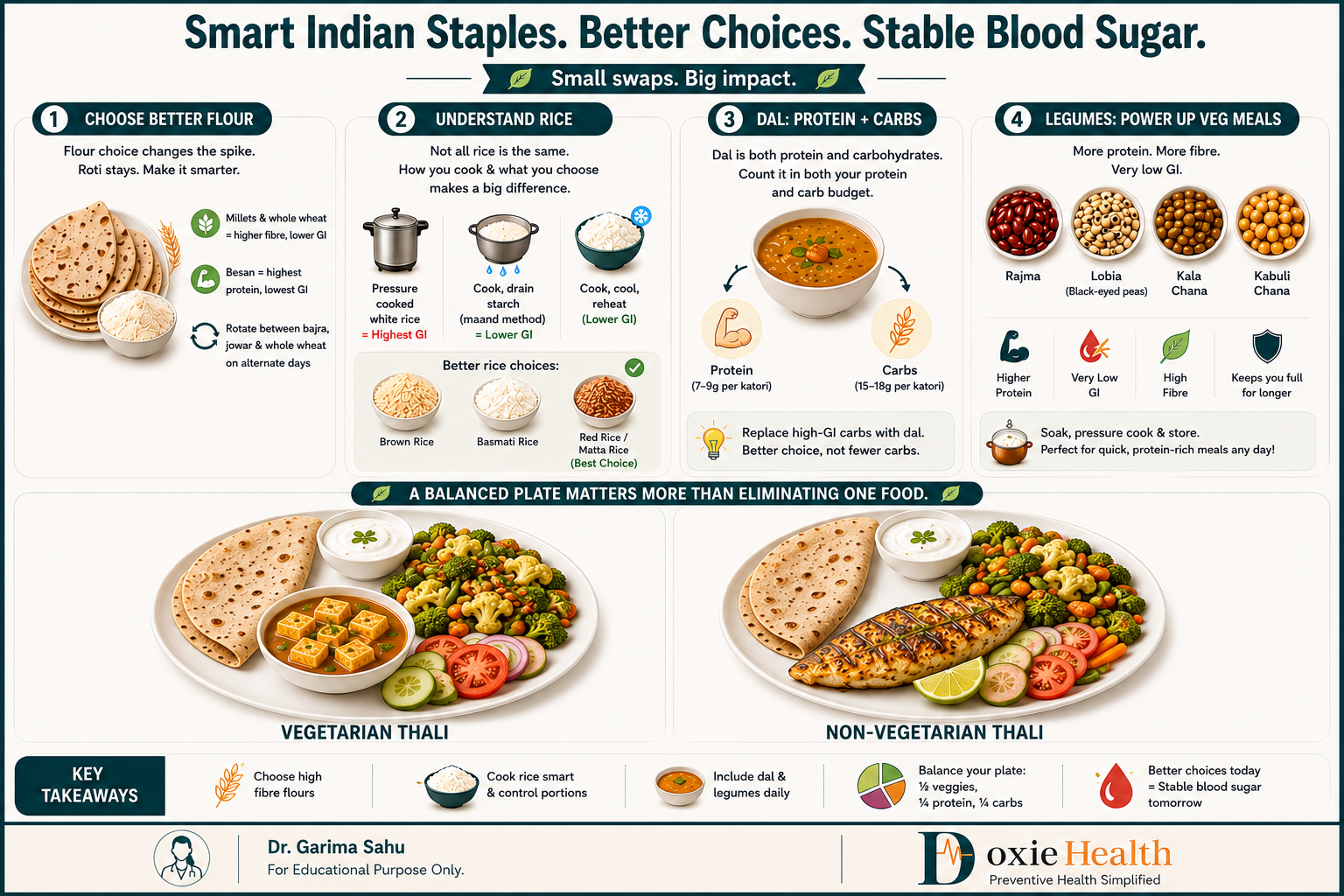
From flour to rice to dal ; small, informed swaps in your everyday Indian kitchen are what actually move your HbA1c. | Image: DoxieHealth
Step 1: Choose Better Flour
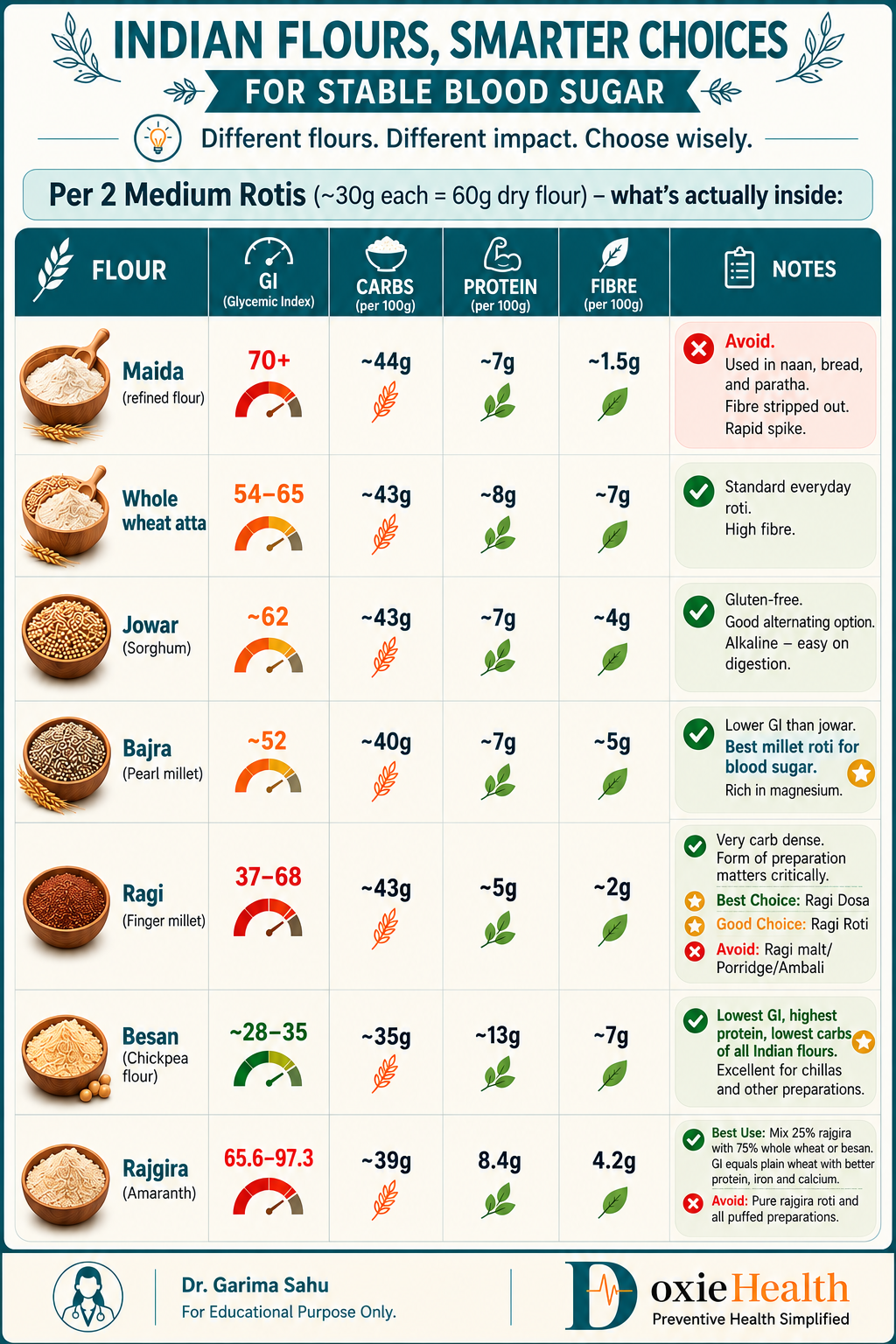
Roti is not going anywhere. But the flour it is made from directly affects how fast blood sugar rises after eating. And flour is not just a carbohydrate; it also provides protein and fibre that matter when you calculate the overall nutrition of your meal.
Per 2 Medium Rotis (~30g each = 60g dry flour)– what’s actually inside:
The flour you choose matters more than you think. Save this guide for healthier everyday choices!
Rotis are not purely carbohydrate foods; they contribute meaningful protein and fibre, particularly bajra and whole wheat. This matters when you plan your full meal targets.
Practical guidance:Rotate between bajra, jowar, and whole wheat on alternate days. This provides variety, a range of micronutrients, and prevents any one grain from dominating your diet. Two small rotis per meal is a reasonable portion to work with. You can add besan to whole wheat roti.
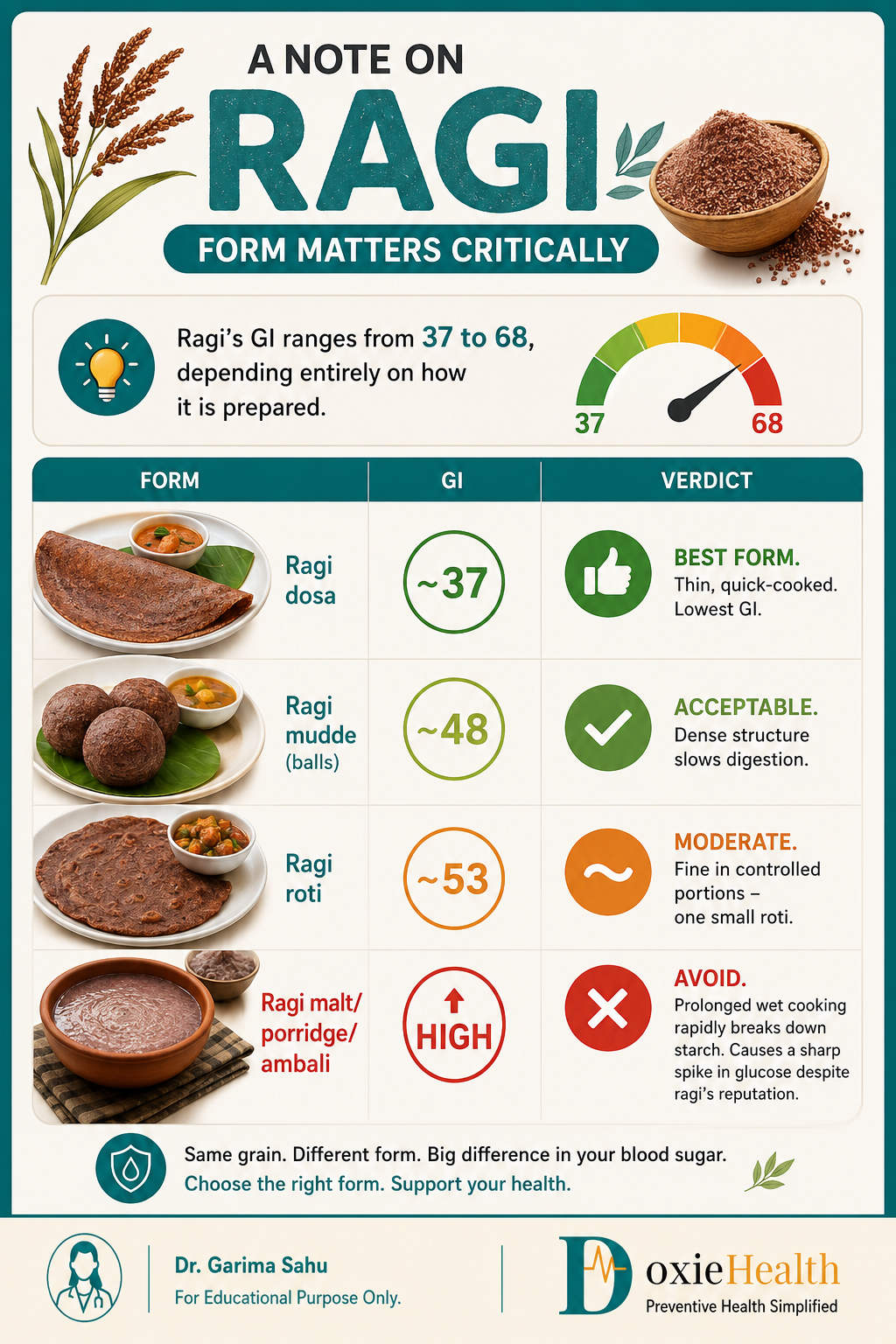
A note on ragi: form matters critically
Ragi is one of the most widely recommended foods for diabetics in India, and one of the most misunderstood. Its GI ranges from 37 to 68, depending entirely on how it is prepared.
The form of ragi matters more than the grain itself. Image: DoxieHealth
A note on ragi: form matters critically
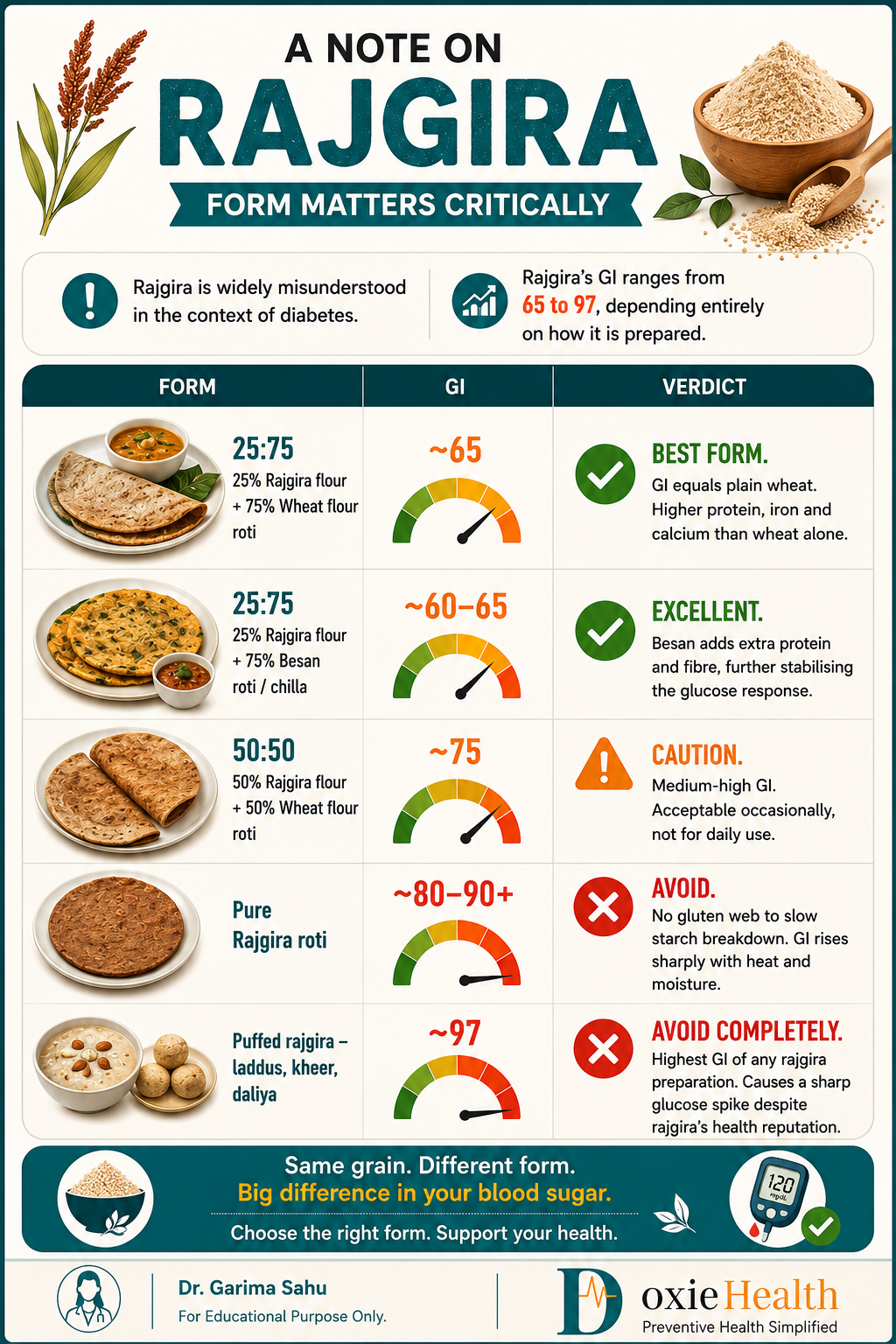
Rajgira is gaining popularity as a healthy, gluten-free alternative flour and like ragi, it is widely misunderstood in the context of diabetes. Its GI ranges from 65 to 97 depending entirely on how it is prepared.
The reason for this dramatic variation is structural: rajgira contains no gluten, which means there is no protein web to slow starch breakdown. The more heat and moisture involved in cooking, the faster the starch gelatinises and the higher the GI climbs.
Rajgira is often considered a diabetes-friendly grain, but its effect on blood sugar depends entirely on how it is prepared. Image: DoxieHealth.
A 25:75 rajgira-wheat roti has a GI of 65.6, essentially the same as plain wheat, with better protein, iron, and calcium.
Puffed rajgira in laddus or kheer reaches a GI of 97.3 – one of the highest recorded for any grain preparation. Use rajgira only in a 25:75 blend with whole wheat or besan. Never as pure rajgira roti, and never in puffed form if you have diabetes.
Step 2: Understand Rice (Chawal) – It Is Not All the Same
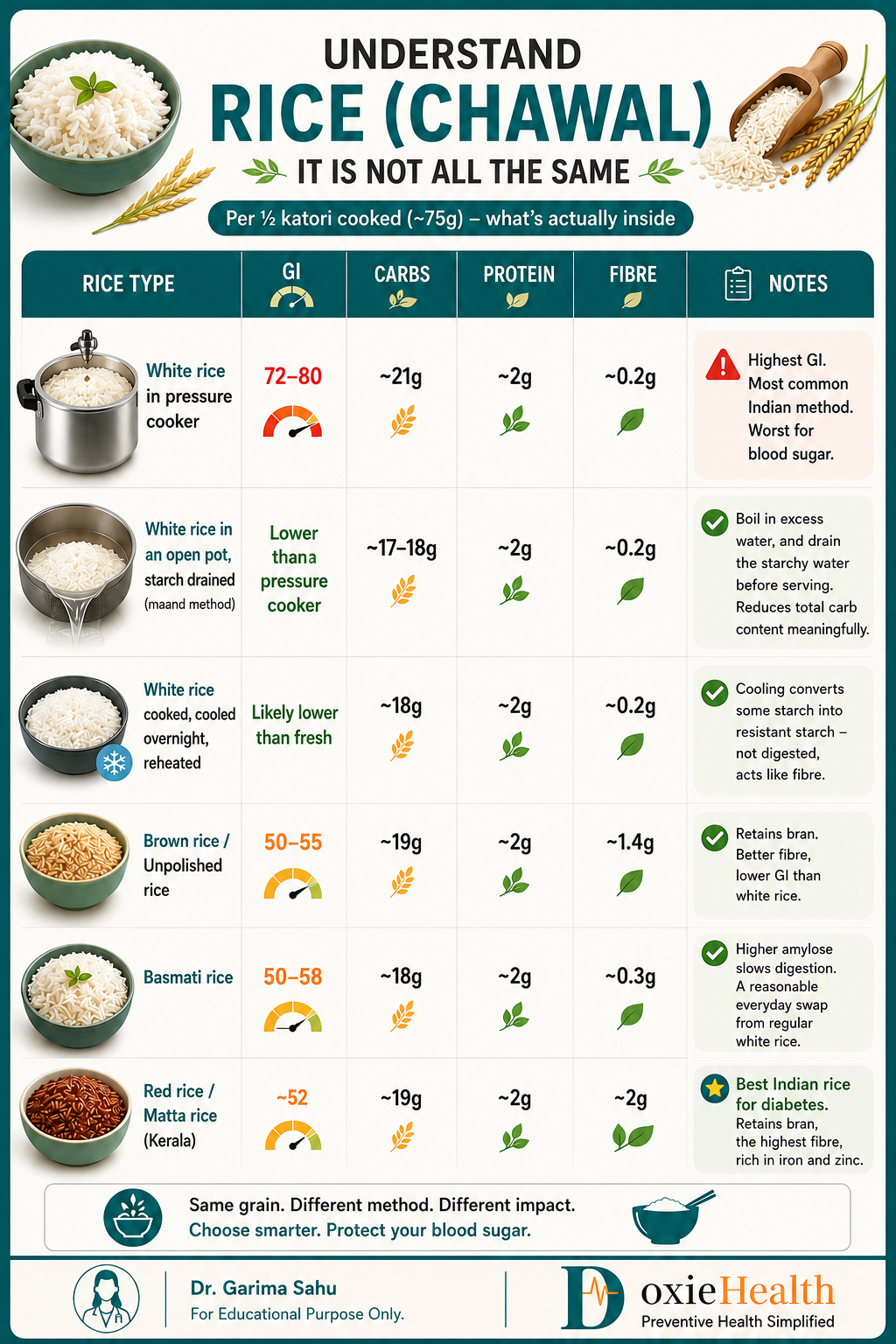
Rice is unavoidable for many Indian families, particularly in South India. The goal is not to eliminate it. It is to understand how you cook it, which variety you choose, and how much ends up on the plate.
Not all rice is equal, and how you cook it matters as much as which type you choose. Red rice is the best Indian option for blood sugar control. | Image: DoxieHealth
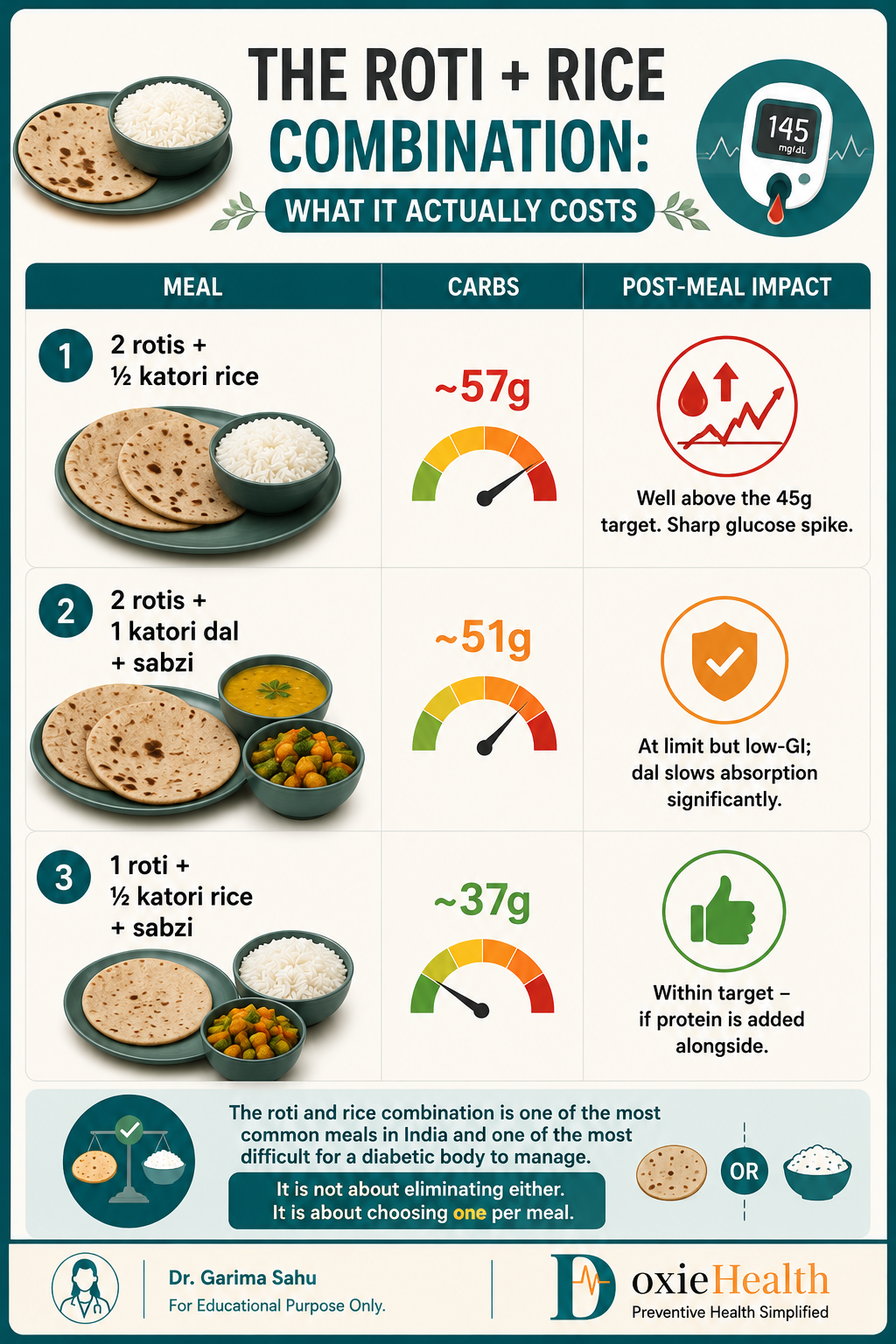
The Roti + Rice Combination: What It Actually Costs
Roti and rice together can quickly increase your carbohydrate intake. Choosing one per meal is often a better strategy for blood sugar control. iMAGE: DoxieHealth
The roti and rice combination is one of the most common meals in India and one of the most difficult for a diabetic body to manage. It is not about eliminating either. It is about choosing one per meal.
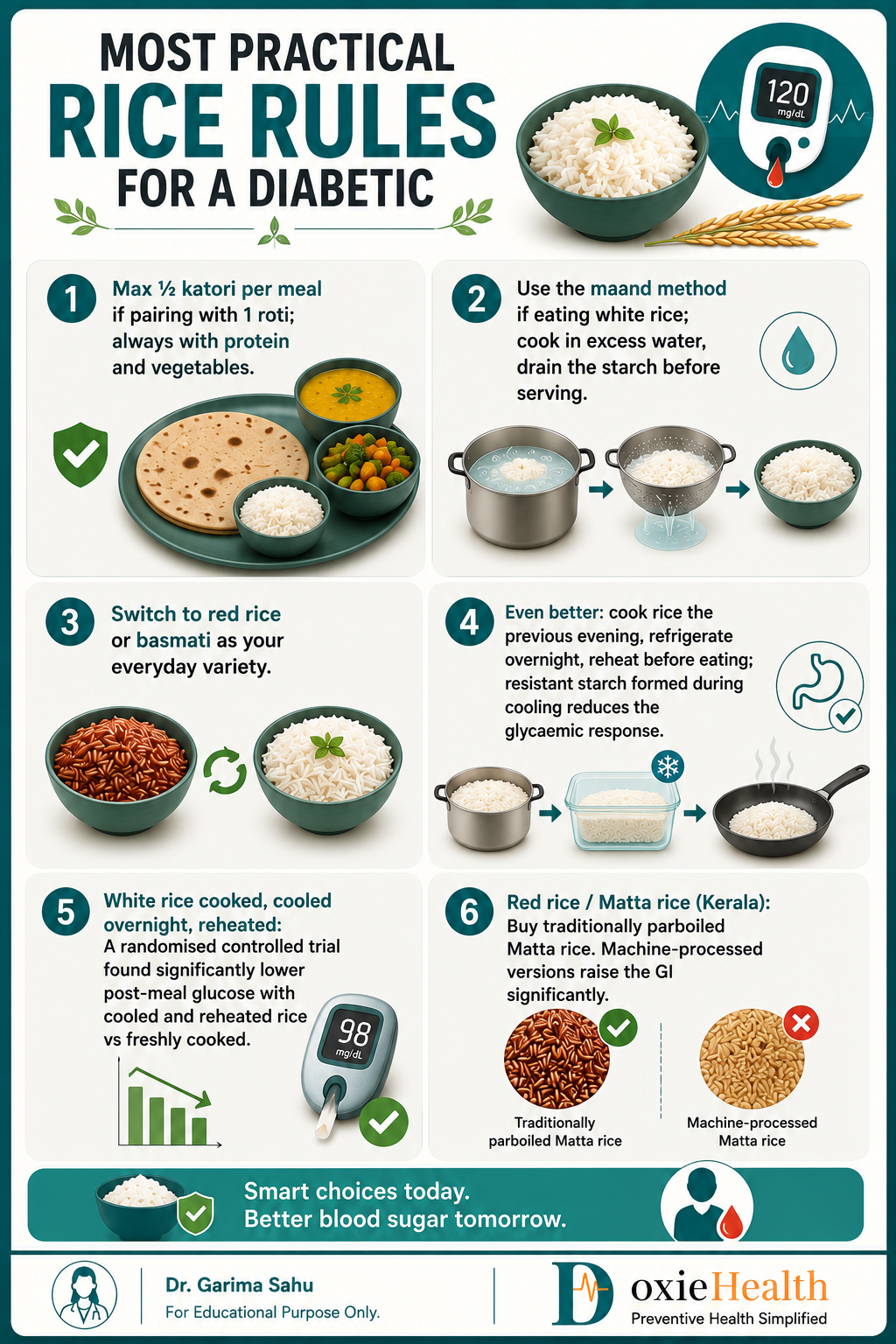
Most practical rice rules for a diabetic:
Simple changes in how you choose, cook, and portion rice can significantly improve blood sugar control. These practical, evidence-based tips help you enjoy rice while making smarter choices for diabetes management.Image: DoxieHealth
Maximum ½ katori per meal if pairing with 1 roti; always alongside protein and vegetables.
Use the maand method if eating white rice; cook in excess water, drain the starch before serving
Switch to red rice or basmati as your everyday variety.
Even better: cook rice the previous evening, refrigerate overnight, reheat before eating; resistant starch formed during cooling reduces the glycaemic response
White rice cooked, cooled overnight, reheated: A randomised controlled trial found significantly lower post-meal glucose with cooled and reheated rice vs freshly cooked.
Red rice / Matta rice (Kerala): Buy traditionally parboiled Matta rice. Machine-processed versions raise the GI significantly.
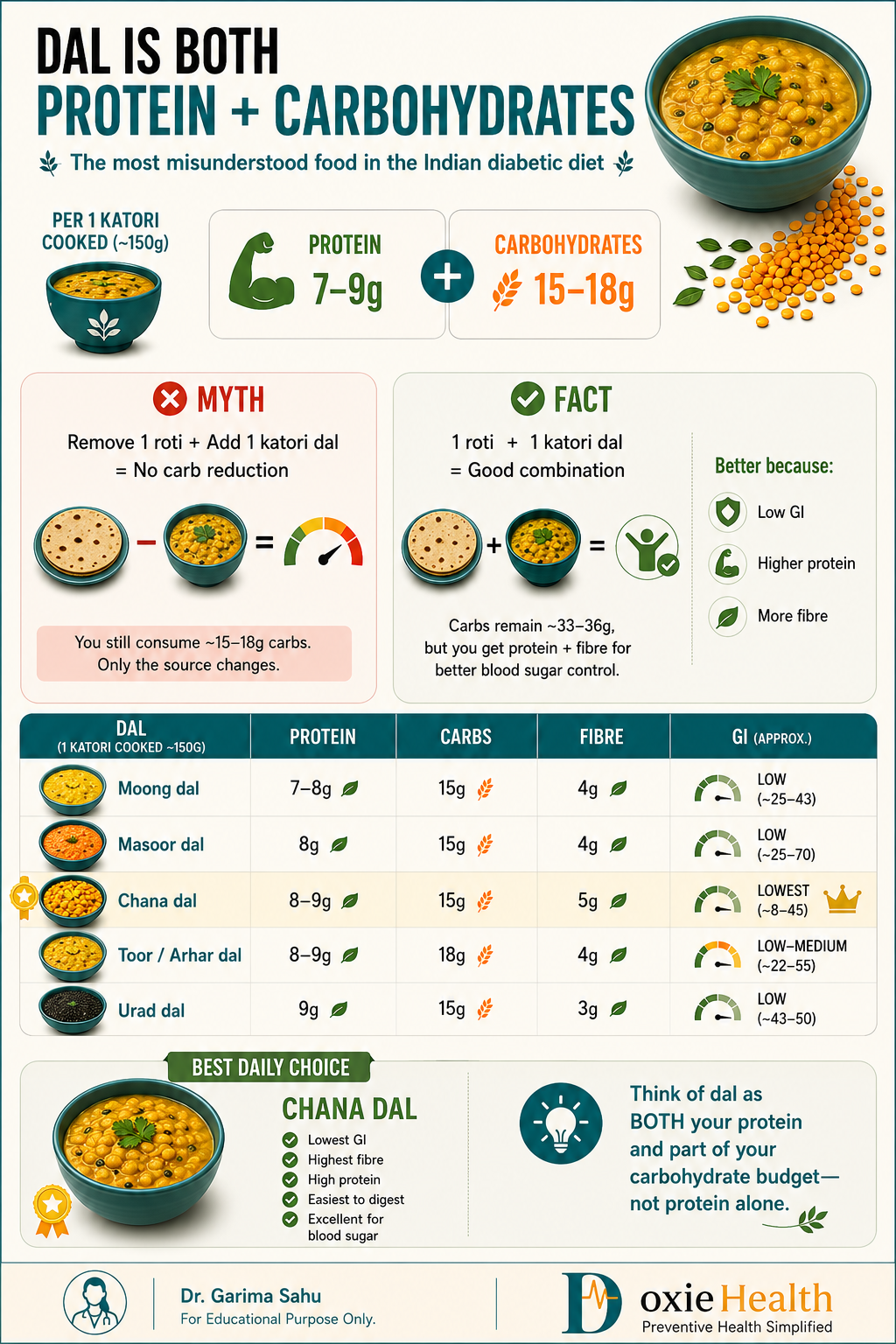
Step 3: Dal (Lentil) Is Both Protein AND Carbohydrates
Dal is consistently treated as a protein food in Indian diets. It is, but it is also a significant source of carbohydrates, and this misunderstanding affects how people plan their meals.
Dal contains approximately 55–60g of carbohydrates per 100g dry weight (uncooked dry dal) alongside 20–25g of protein. When cooked, 1 katori of dal provides roughly 7–9g of protein and 15–18g of carbohydrates.
If you remove one roti from your meal (saving ~18g carbs) and add a katori of dal (~15g carbs), you have not significantly reduced your carbohydrate intake. What you have done is replace a high-GI carb with a low-GI carb that also contains protein, which is genuinely better, but not the same as cutting carbs.
The right way to think about dal: a low-GI dual source; count it as both your protein and part of your carbohydrate budget.
Dal is not just a protein—it also contributes to your carbohydrate intake. Learn how to count dal correctly, compare common Indian lentils, and choose the best options for better blood sugar control.Image:DoxieHealth
GI is not a fixed number – it changes based on how a food is prepared. The same dal cooked whole with soaking has a lower GI than when split and pressure-cooked. Longer soaking, slower cooking, and keeping the husk intact all lower the response. Chana dal consistently comes out lowestacross studies because of itsunusually high amylose content and dense fibrestructure,both of which slow digestion regardless of preparation method. The best daily choices: lowest GI, easiest to digest, quick to cook.
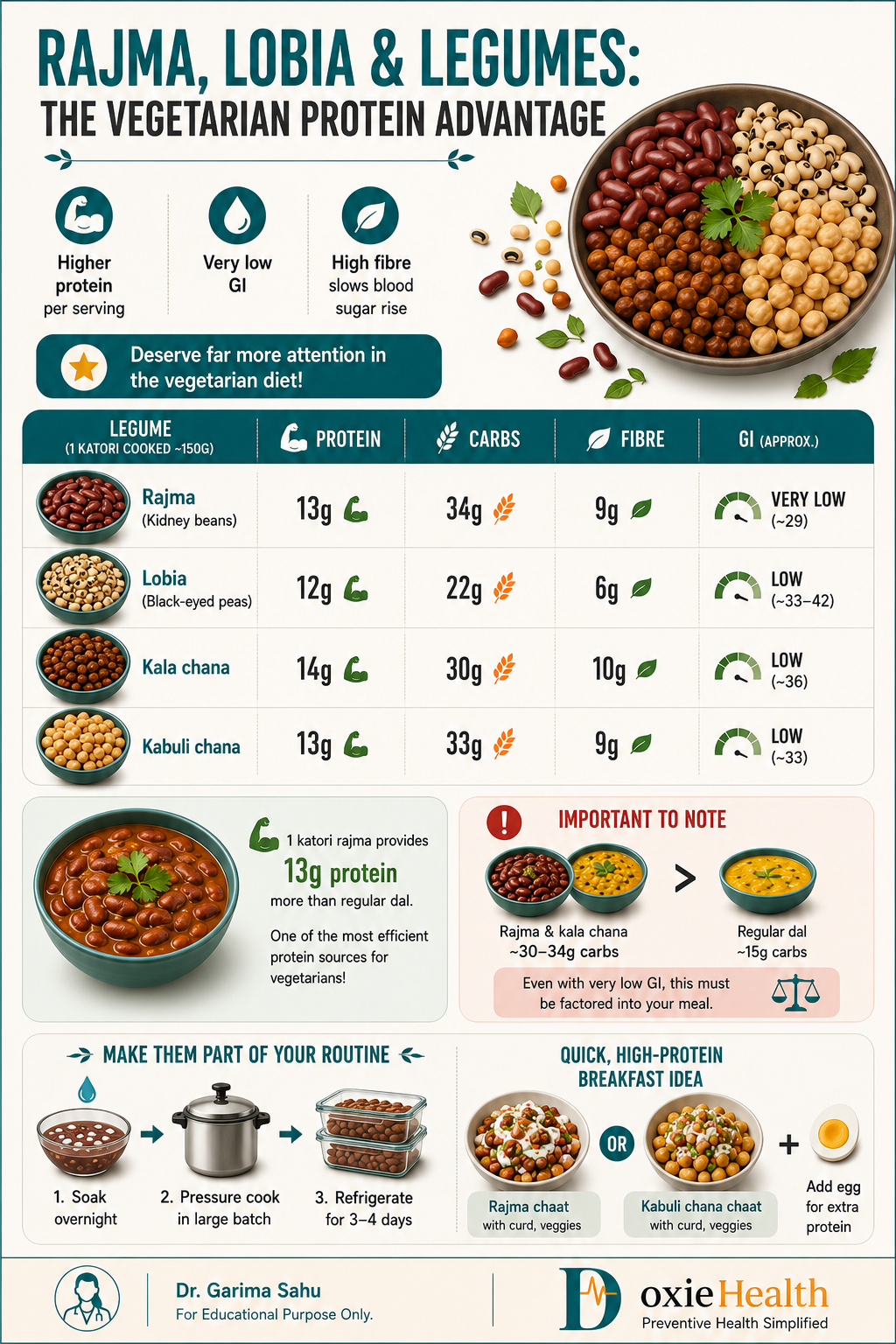
Step 4: Rajma, Lobia & Legumes: The Vegetarian Protein Advantage
For vegetarians, these deserve far more attention than they typically get. They offer significantly more protein per serving than regular dal, have a very low GI, and their high fibre content further slows the blood sugar response.
Rajma, lobia, and chickpeas are among the best vegetarian protein sources for people with diabetes. They provide substantially more protein than regular dal and have a low glycemic index, but their higher carbohydrate content still needs to be counted when planning balanced meals.Image: DoxieHealth
One katori of rajma provides 13g of protein, more than regular dal. For vegetarians, this is one of the most efficient protein sources in an Indian kitchen.
However, rajma and kala chana carry significantly more carbohydrates per serving than regular dal (~30–34g vs ~15g). Even with a very low GI, this must be factored in.
Soak and pressure-cook a large batch every 3–4 days, then refrigerate. On a busy morning, these can also become a quick, high-protein breakfast (rajma, kabuli chana chaat along with curd, egg).
Step 5: How Much Per Meal?
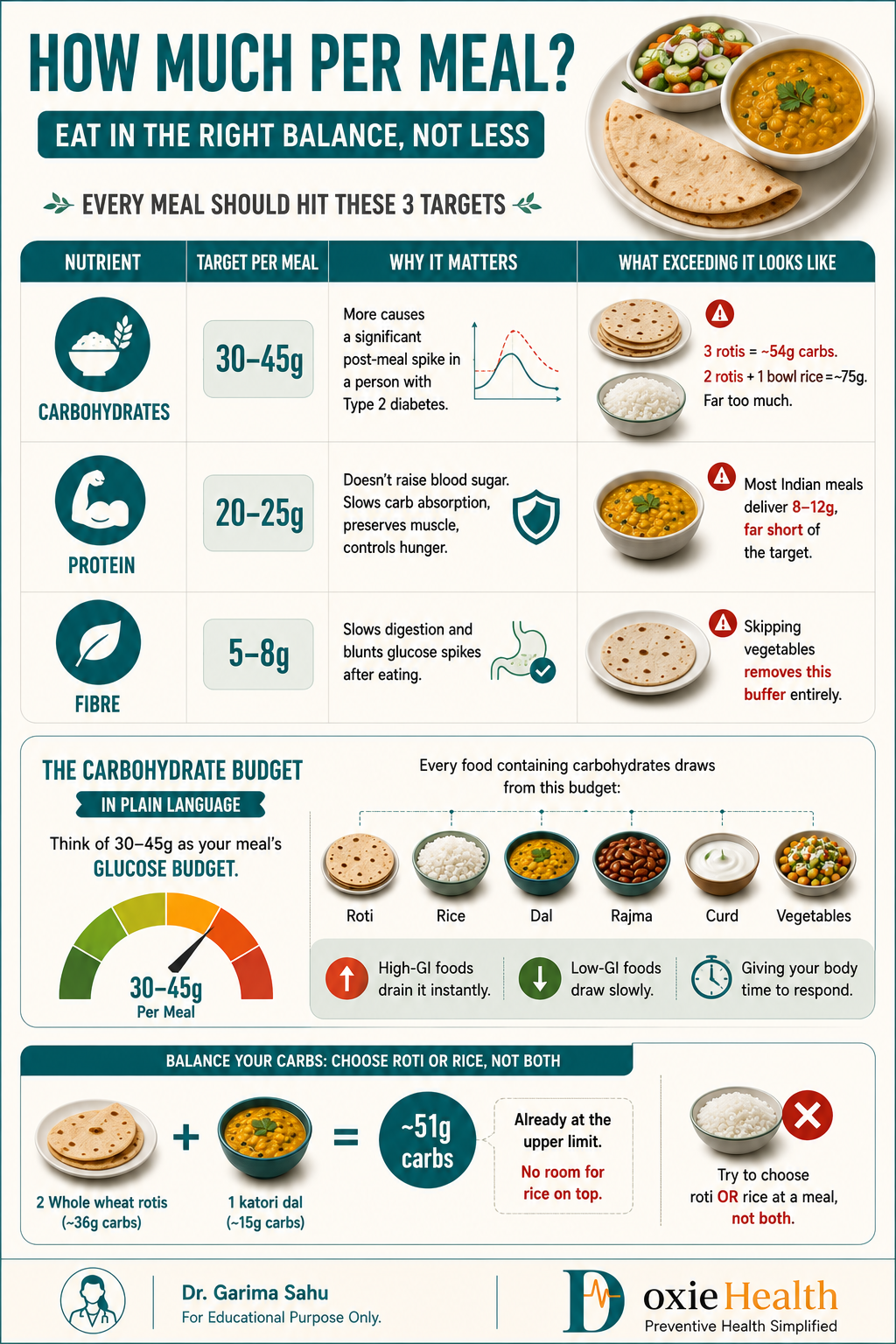
Now that you know what each part of your Indian meal actually contains, the next step is putting it together correctly. The goal is not to eat less – it is to eat in the right balance. Every meal should aim to hit three targets:
A diabetes-friendly meal isn’t about eating less—it’s about balancing carbohydrates, protein, and fibre. Learn the ideal nutrient targets per meal, understand your carbohydrate budget, and see how simple changes in portion sizes can help keep blood sugar more stable.Image:DoxieHealth
The carbohydrate budget in plain language:
Think of 30–45g as your meal’s glucose budget. Every food containing carbohydrates draws from this budget: rotis, rice, dal, rajma, curd, and even vegetables. High-GI foods drain it instantly. Low-GI foods draw slowly, giving your body time to respond.
2 whole wheat rotis (~36g carbs) + 1 katori dal (~15g carbs) = ~51g carbs – already at the upper limit. No room for rice on top. Try to choose roti or rice at a meal, not both.
Now, Put It On Your Plate
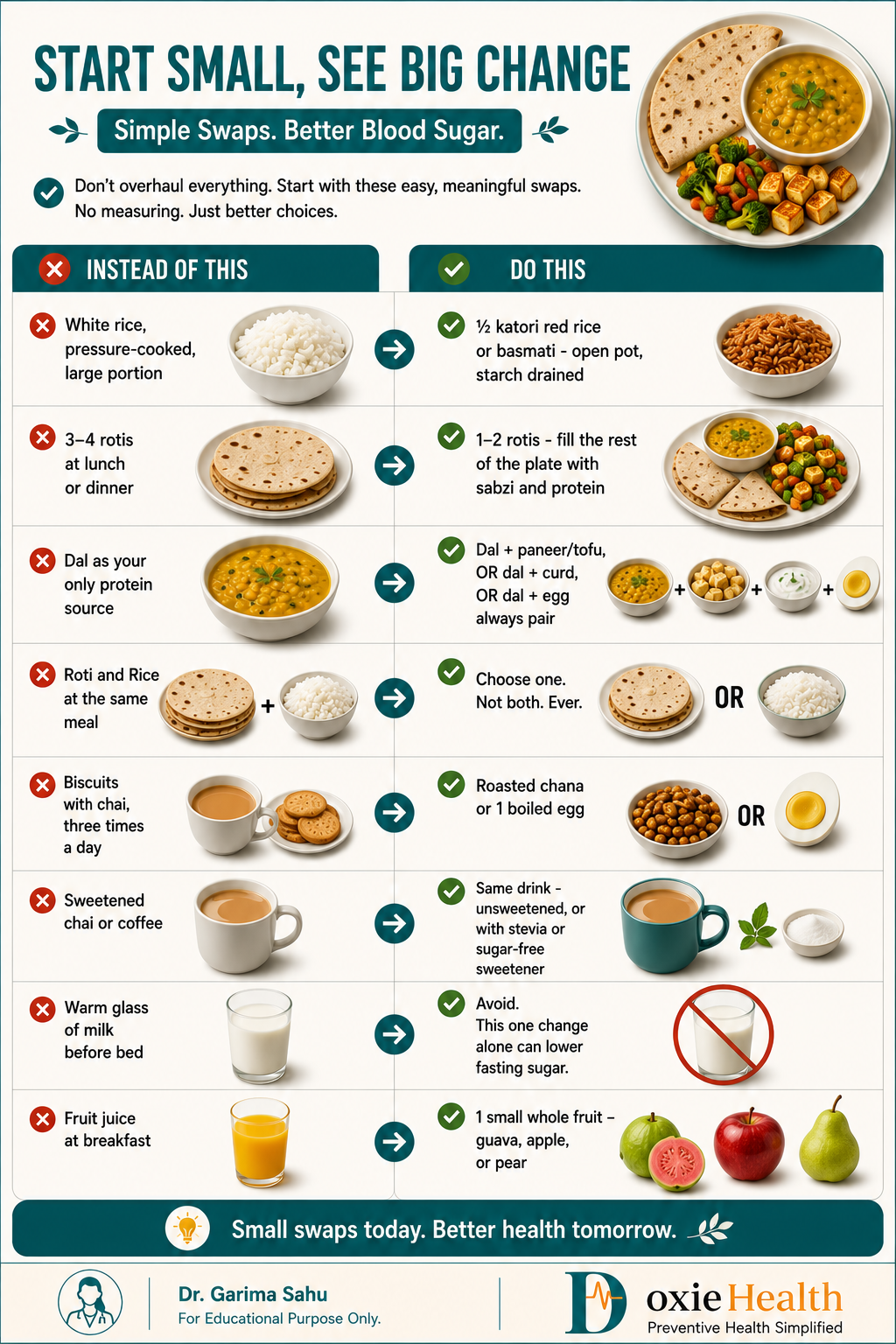
Start With These Swaps
Do not overhaul everything at once. Begin here. Each swap below is an immediate, meaningful change, no measuring required.
Managing diabetes doesn’t require a complete diet overhaul. Simple, practical food swaps—such as choosing red rice over white rice, pairing dal with protein, and replacing biscuits with roasted chana or eggs—can make a meaningful difference to your blood sugar while keeping your meals familiar.Image:DoxieHealth
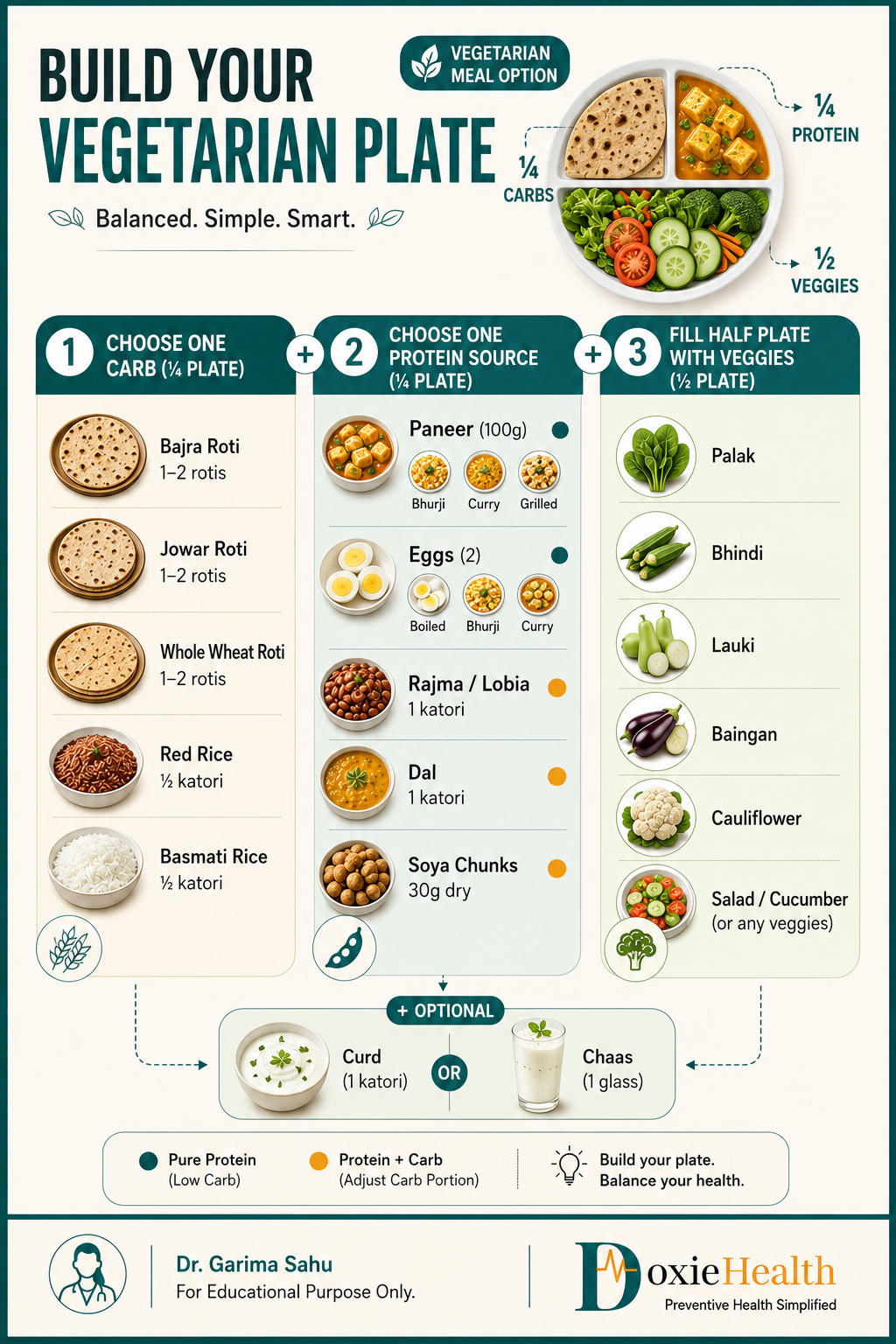
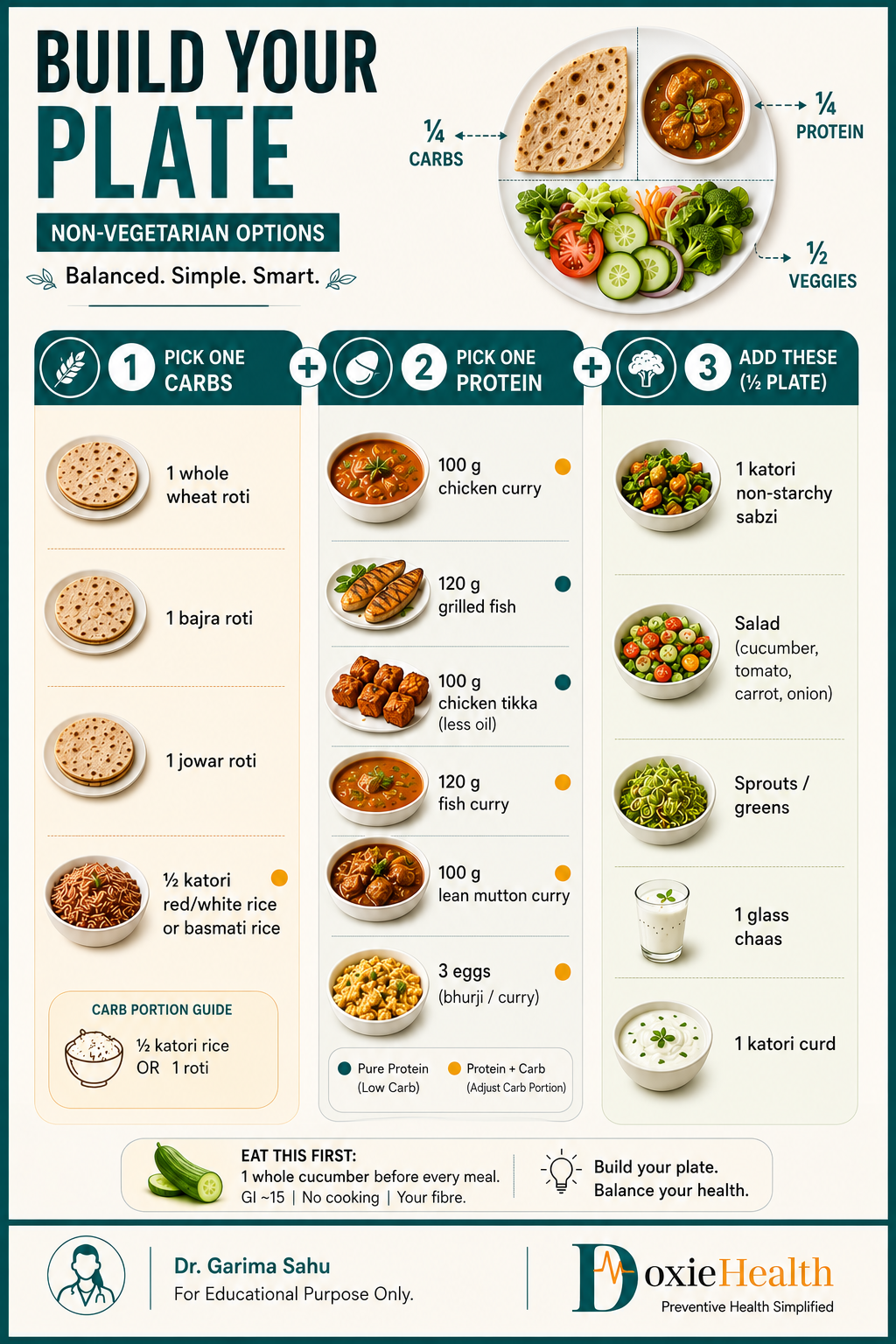
Build Your Meal (Lunch & Dinner) – Pick One From Each Column
Build a balanced diabetes-friendly plate by choosing one healthy carbohydrate, one protein source, filling half your plate with non-starchy vegetables, and adding curd or chaas for a complete Indian meal.Build a balanced diabetes-friendly non-vegetarian plate by choosing one healthy carbohydrate, one lean protein source, filling half your plate with non-starchy vegetables, and adding curd or chaas for a complete Indian meal.Image:DoxieHealth
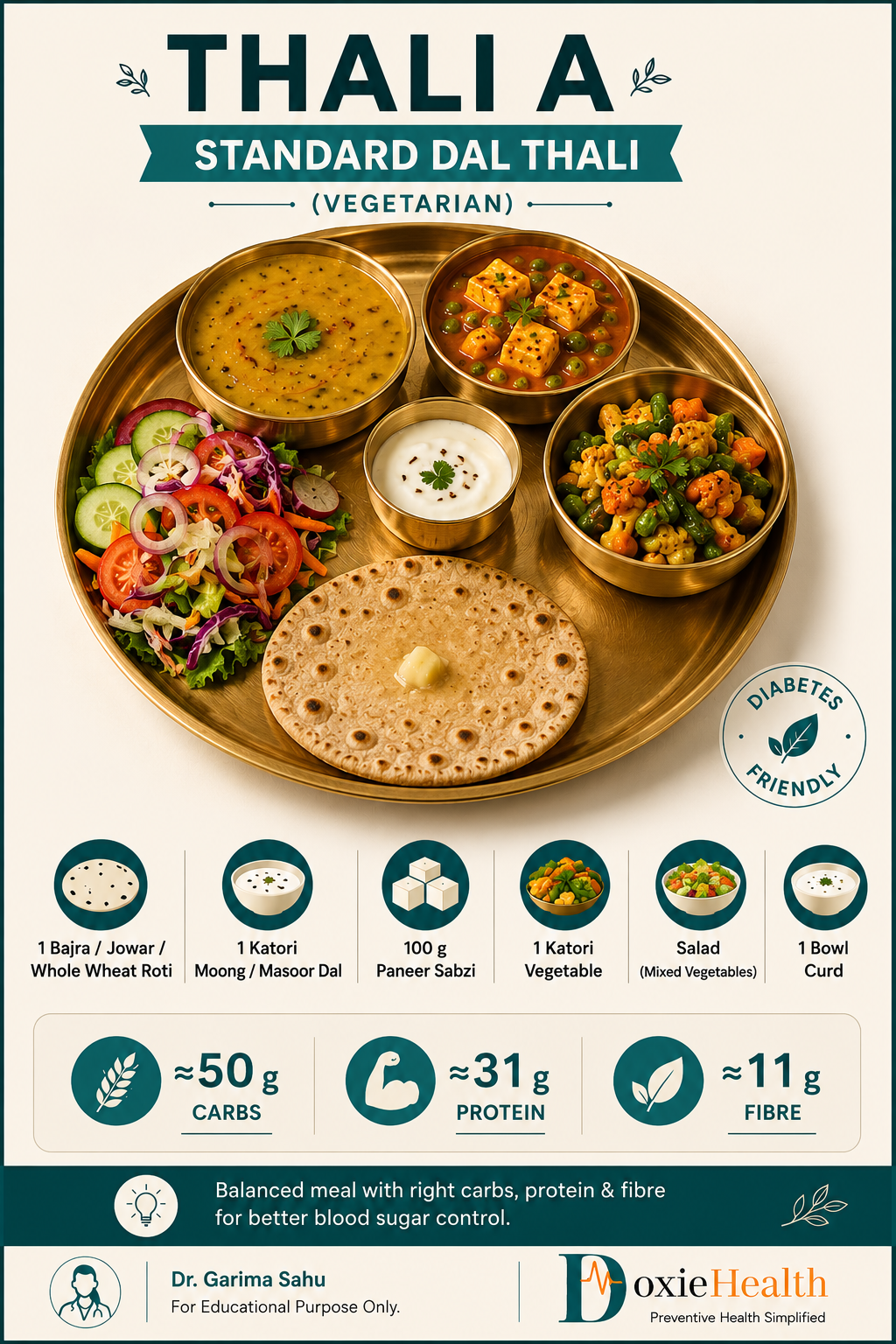
Thali A: Standard Dal Thali (Vegetarian)
A balanced diabetes-friendly vegetarian thali featuring one roti, dal, paneer sabzi, non-starchy vegetables, mixed salad, and curd. This meal provides approximately 50 g carbohydrates, 31 g protein, and 11 g fibre to support better blood sugar control.
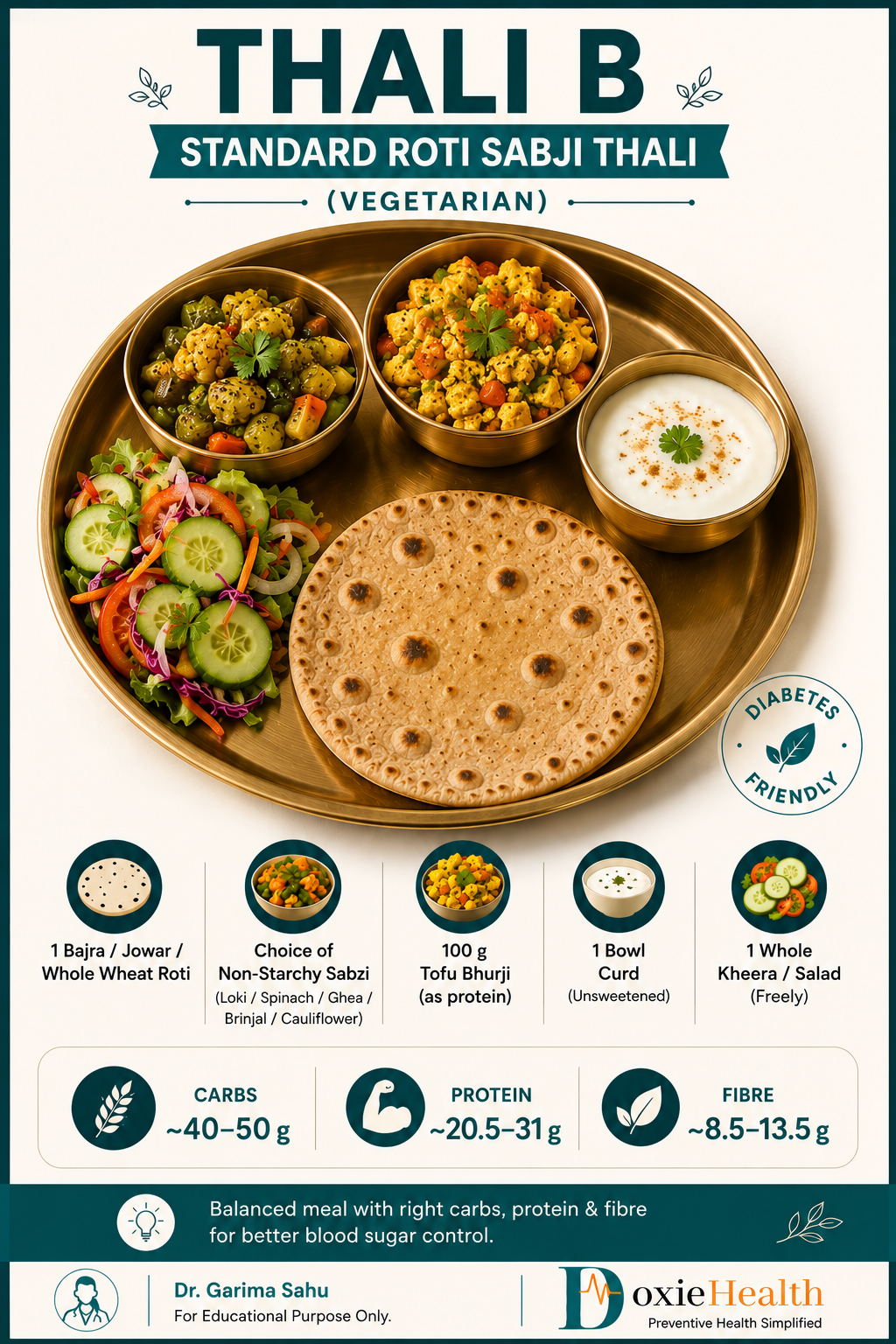
Thali B: Standard Roti Sabji Thali (Vegetarian)
A balanced diabetes-friendly vegetarian roti sabzi thali featuring one healthy roti, non-starchy vegetable sabzi, tofu bhurji, unsweetened curd, and fresh salad. This meal provides approximately 40–50 g carbohydrates, 20.5–31 g protein, and 8.5–13.5 g fibre to support better blood sugar control.
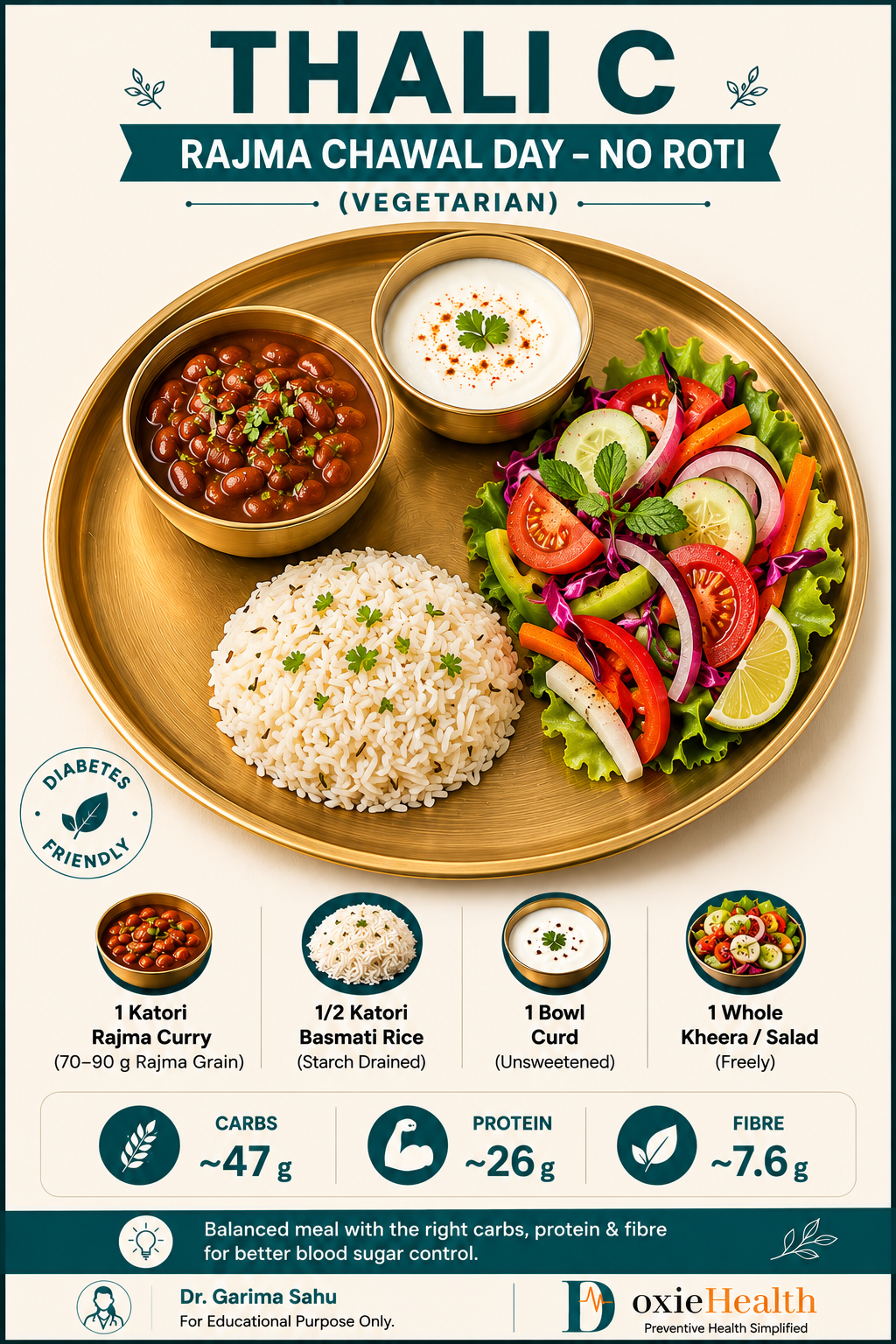
Thali C: Rajma Chawal Day – No Roti
A balanced diabetes-friendly Rajma Chawal thali featuring one katori rajma curry, half katori starch-drained basmati rice, unsweetened curd, and a generous mixed salad. This meal provides approximately 47 g of carbohydrates, 26 g of protein, and 7.6 g of fibre for better blood sugar control.Image:DoxieHealth
Rajma’s GI is very low (~29). The blood sugar response is slow and gradual, meaningfully different from the same carb count coming from roti or rice.
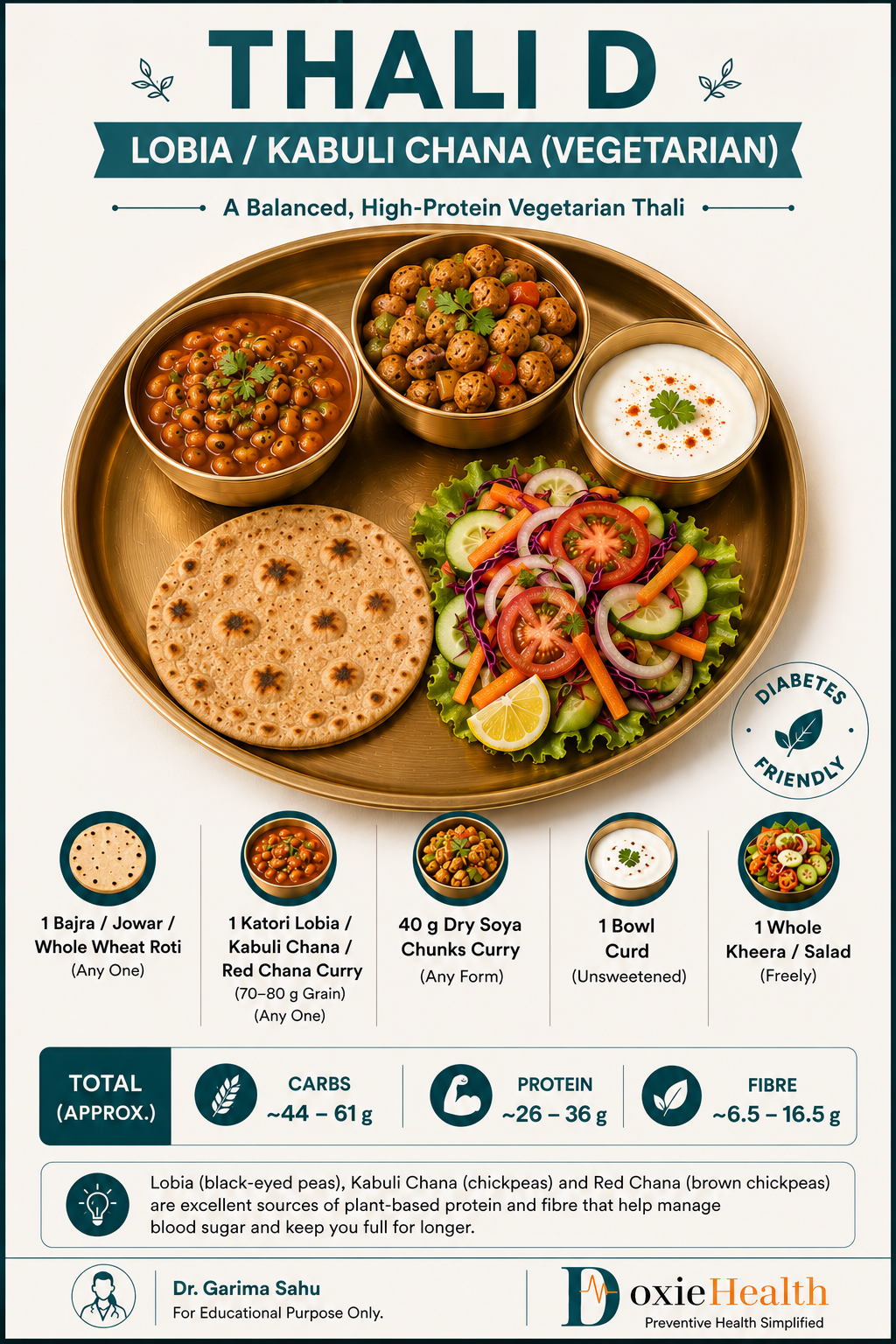
Thali D: Lobia/Kabuli Chana(Vegetarian)
A balanced diabetes-friendly vegetarian thali featuring one healthy roti, one katori of lobia, kabuli chana or red chana curry, dry soya chunks curry, unsweetened curd, and a generous mixed salad. Depending on your legume choice, this meal provides approximately 44–61 g carbohydrates, 26–36 g protein, and 6.5–16.5 g fibre to support better blood sugar control.Image: DoxieHealth
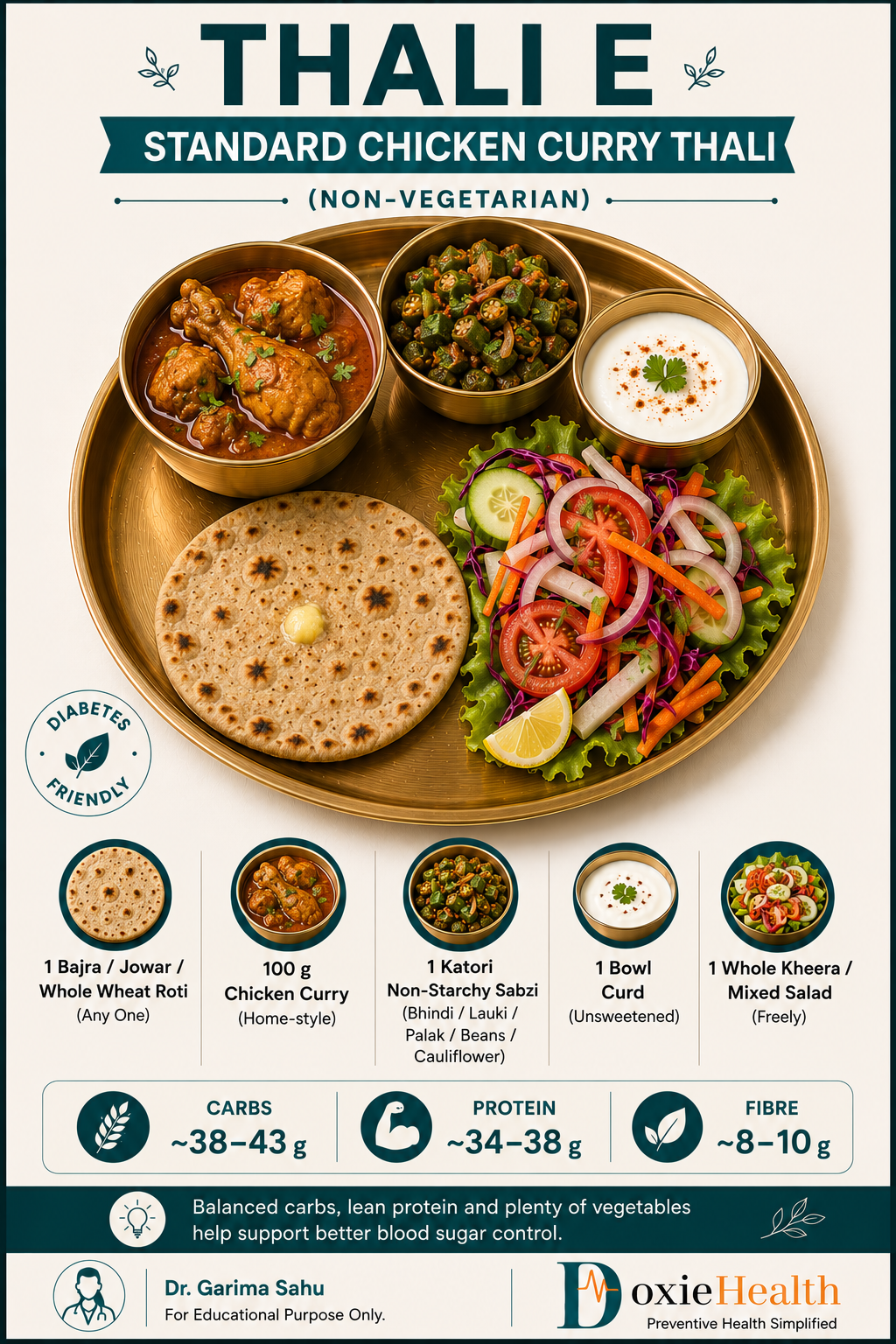
Thali E: Non-Vegetarian
A high-protein non-vegetarian thali built for blood sugar control — whole grain roti, lean chicken or eggs, unsweetened curd, and a generous salad. Protein and carbs in the right balance. | Image: DoxieHealth
Hits all three targets well. Non-vegetarians have a clear advantage: high protein without the additional carb load that vegetarian protein sources carry.
Choose lean cuts of mutton and trim visible fat. Limit red meat to 1–2 meals per week, and prefer chicken or fish more often for heart health.
Build Your Breakfast
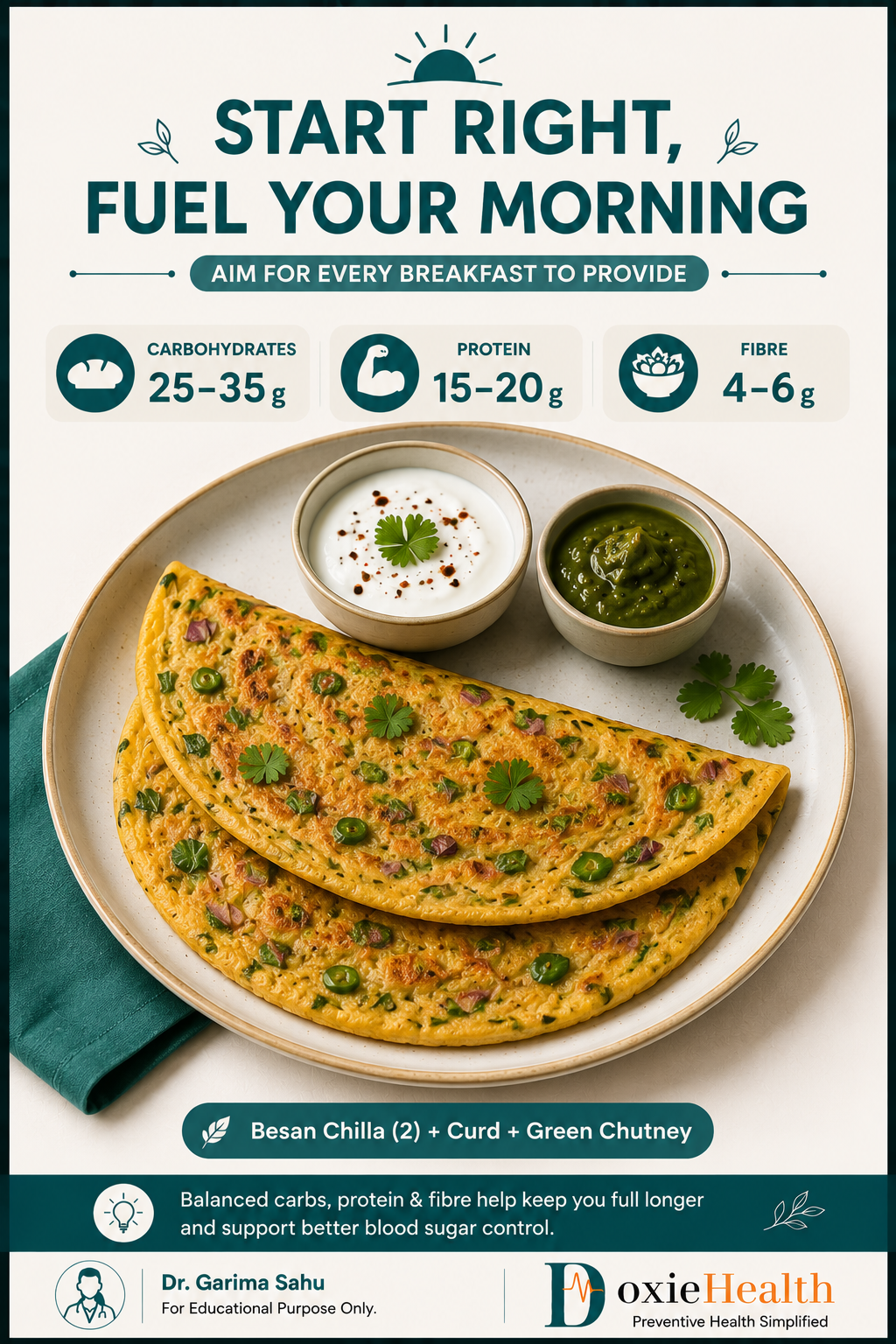
Aim for every breakfast to provide:
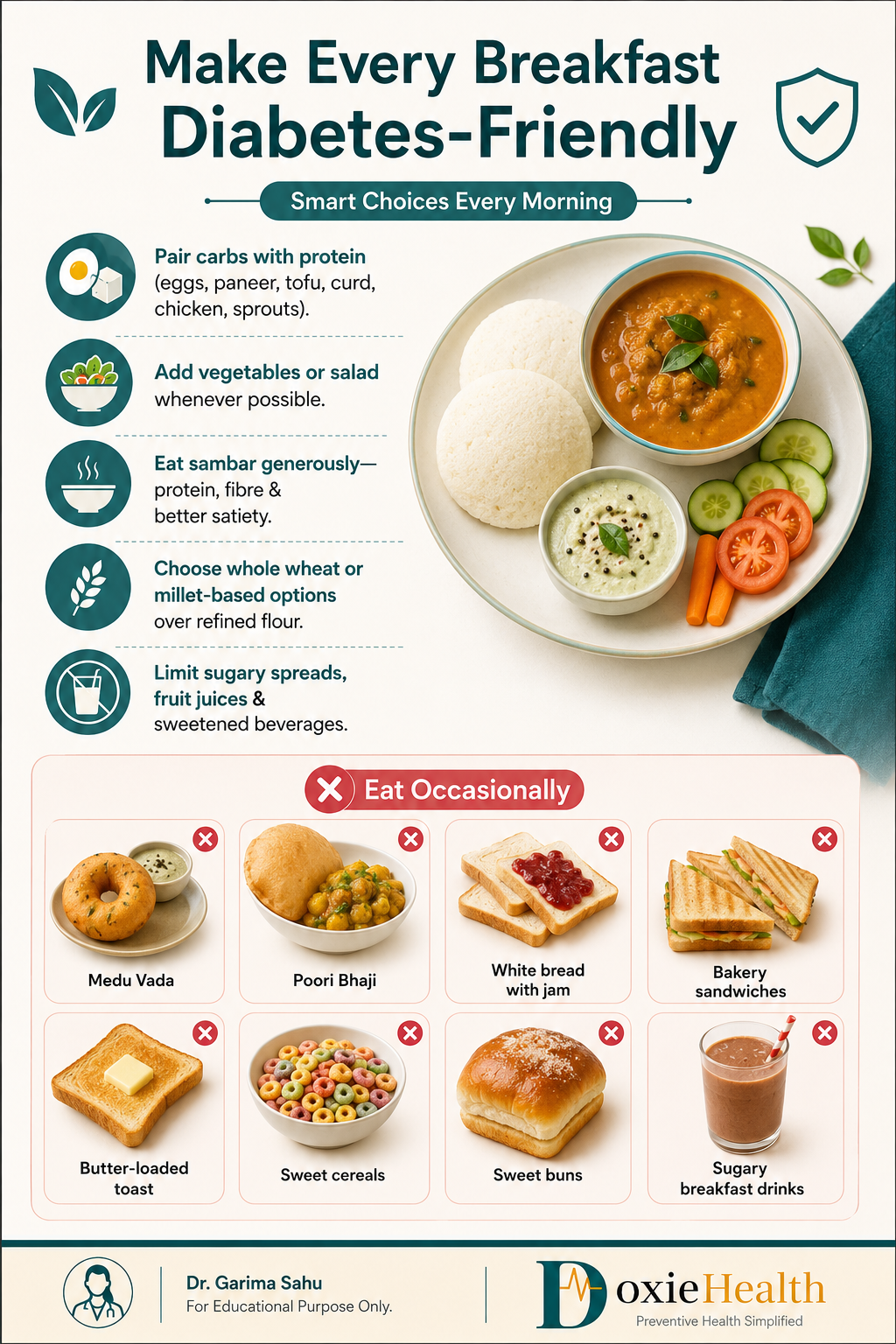
Your breakfast sets the tone for your blood sugar for the rest of the day. Image:DoxieHealth
Tip: Pair every carbohydrate with a good protein source to slow glucose absorption and keep you full for longer.
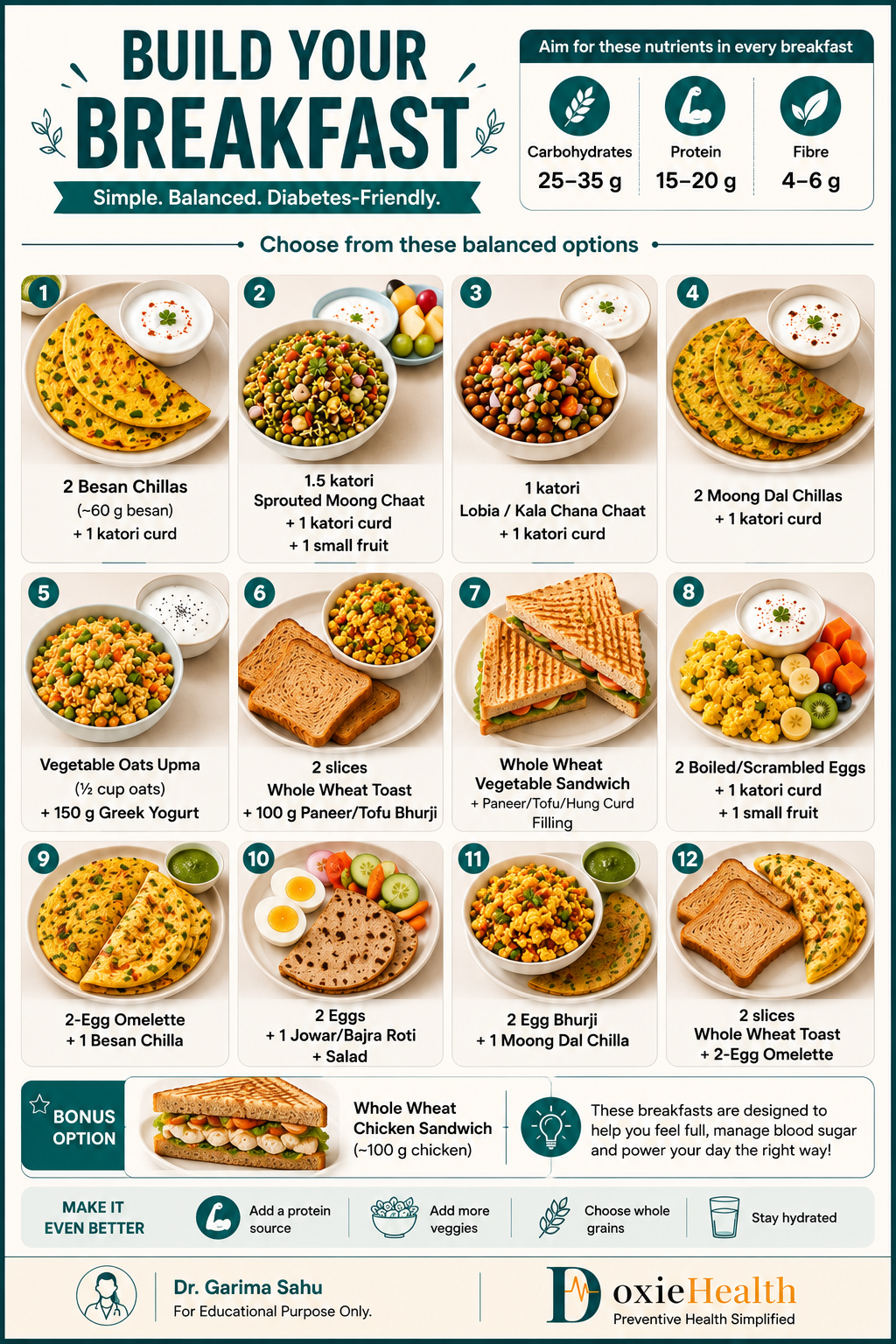
Balanced Breakfast Options
Build a breakfast that keeps you full and your blood sugar steady.Image:DoxieHealth
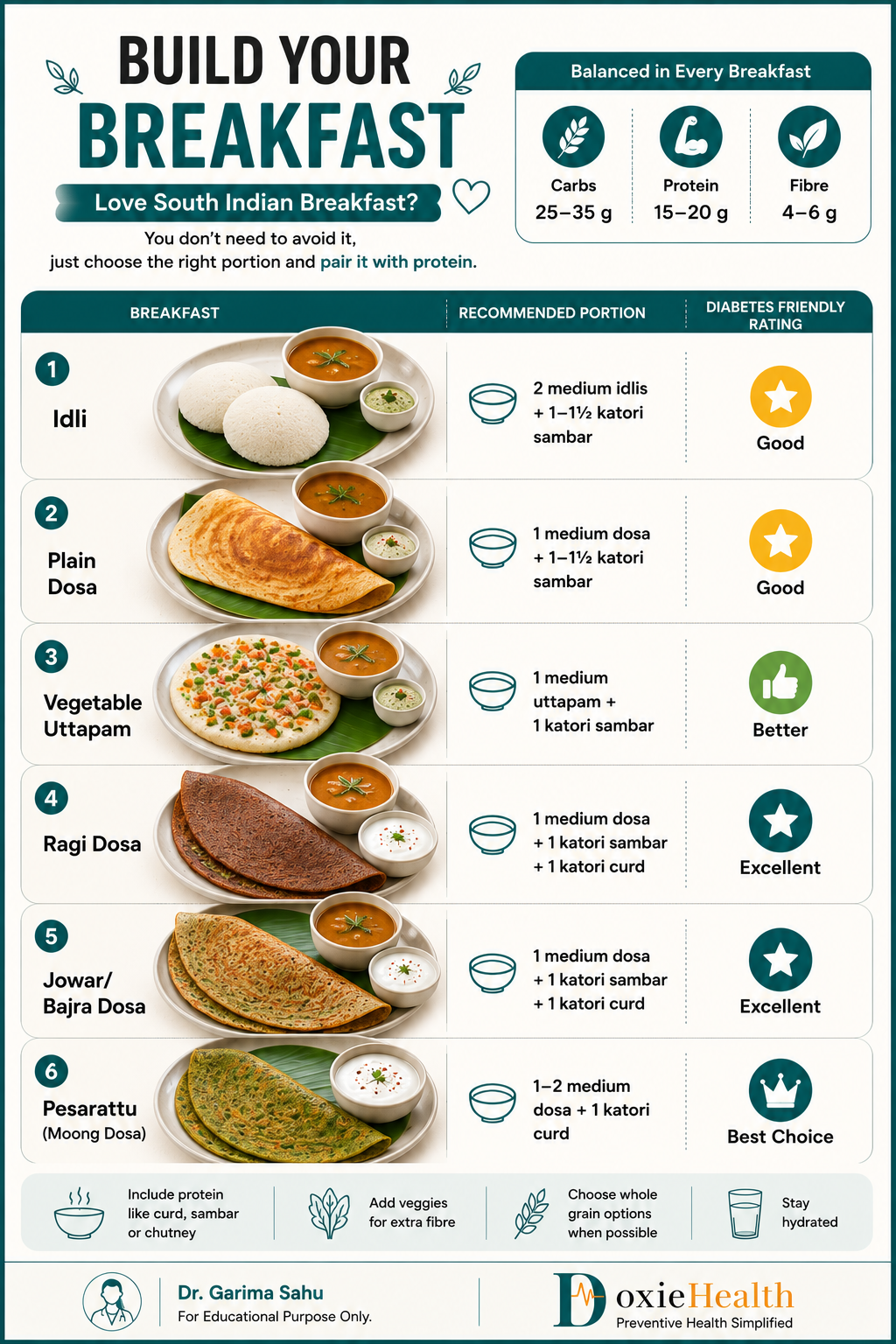
Love South Indian Breakfast?
You don’t need to avoid it, just choose the right portion and pair it with protein.
Love South Indian breakfast? You don’t have to give it up. Image:DoxieHealth
For busy mornings: Sprouted moong, boiled lobia, boiled rajma, and boiled eggs can be batch-prepped and refrigerated for 3–4 days. Breakfast becomes two minutes of portioning.
Make Every Breakfast Diabetes-Friendly
Your breakfast doesn’t have to be perfect-just a little smarter.
✅ Pair carbohydrates with protein (eggs, paneer, tofu, curd, chicken, sprouts).
✅ Prefer whole wheat or millet-based options over refined flour.
✅ Limit sugary spreads, fruit juices, and sweetened beverages
Eat Occasionally
Medu Vada
Poori Bhaji
White bread with jam
Bakery sandwiches
Butter-loaded toast
Sweet cereals
Sweet buns
Sugary breakfast drinks
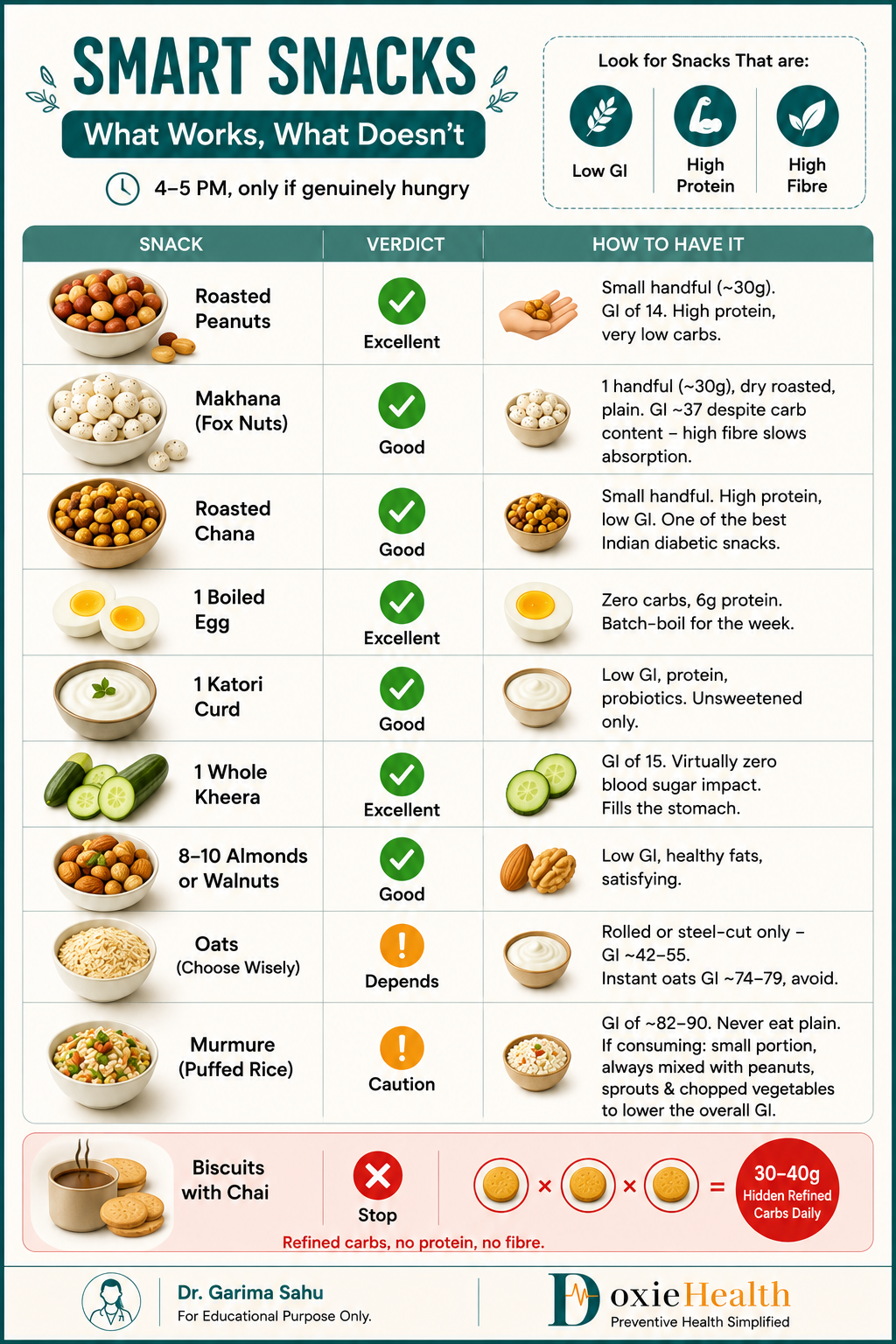
Snacks: What Works, What Doesn’t (4–5 PM, only if genuinely hungry)
Hungry between meals? Snack smarter, not more.Image:DoxieHealth
Tea and coffee: Tea and coffee themselves are not the problem. The problem is what goes in them. Two teaspoons of sugar per cup, four cups a day = 8 teaspoons of sugar daily that most people forget to count. Switch to unsweetened, or use stevia or sugar-free. A small amount of milk in tea adds only 2–3g of carbs per cup. The sugar is the issue.
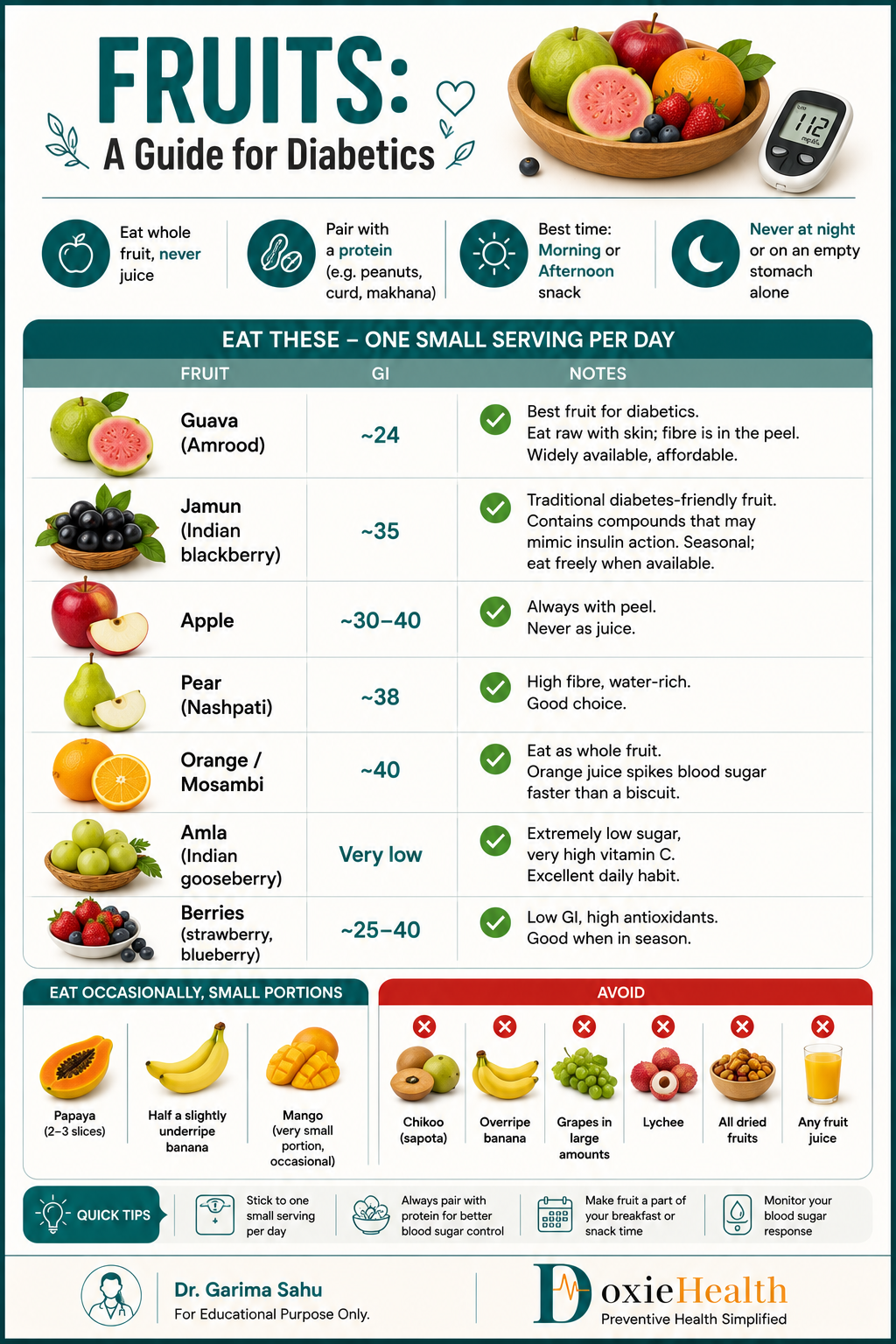
Fruits: A Guide for Diabetics
Fruits are not off-limits. What matters is which fruit, how much, and when. Always eat whole fruit, never juice. Pair with a protein (a few peanuts, curd, makhana).Best time: morning or afternoon snack. Never at night or on an empty stomach alone.
Eat These – One Small Serving Per Day
Can people with diabetes eat fruit? Absolutely! Image:DoxieHealth
Eat occasionally, small portions: Papaya (2–3 slices), half a slightly underripe banana, mango (very small portion, occasional).
Avoid: Chikoo (sapota), overripe banana, grapes in large amounts, lychee, all dried fruits, and any fruit juice of any kind.
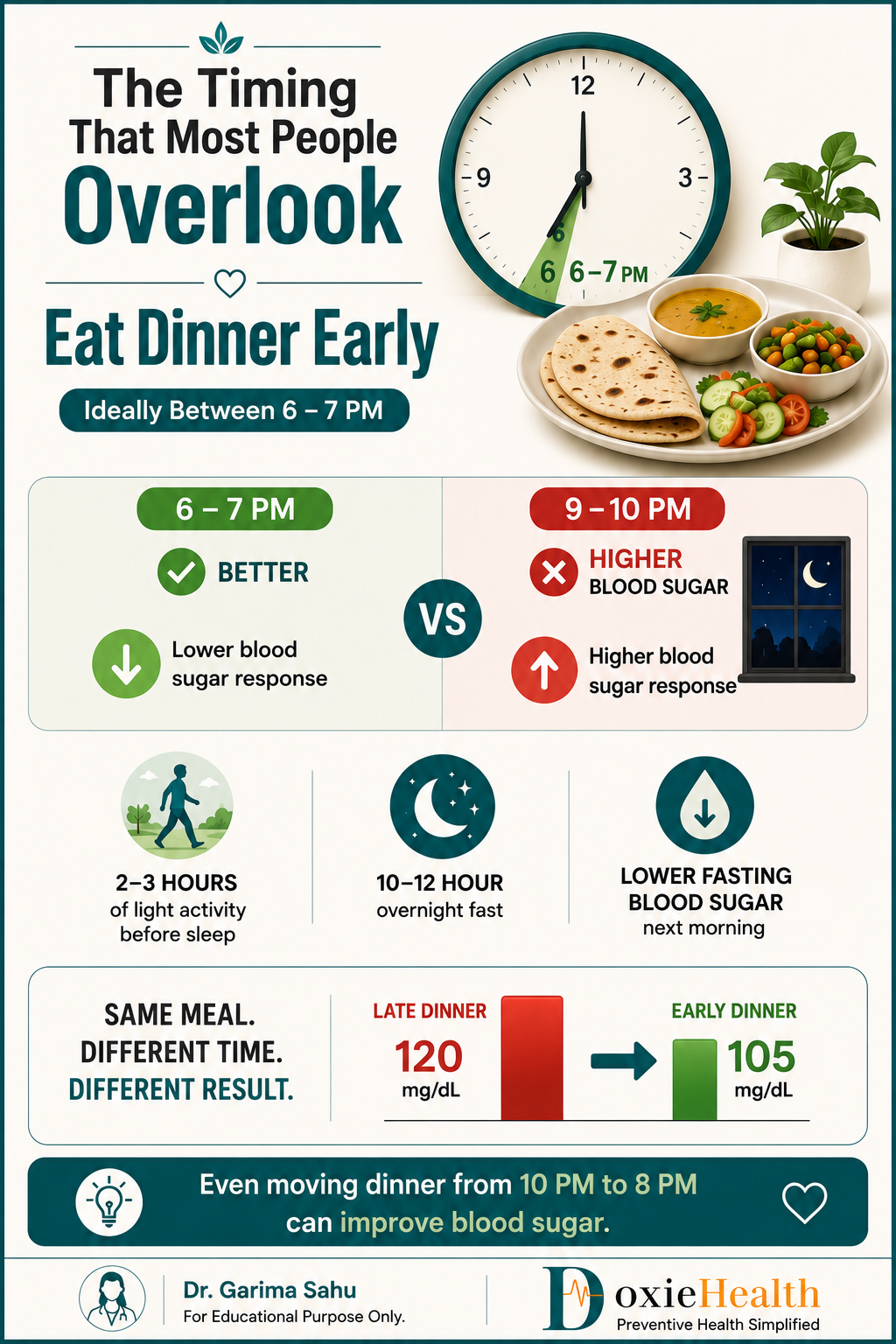
The Timing That Most People Overlook
Eat Dinner Early; Ideally Between 6 and 7 PM
The timing of your dinner may matter just as much as what’s on your plate.
Most Indians eat dinner between 9 PM and 10 PM. This single habit may be doing more damage to blood sugar than anything on the plate.
The body’s ability to handle glucose follows a circadian rhythm; it is significantly better in the morning and progressively worsens through the day.
Research confirms this clearly: The same meal eaten at 6 PM causes a meaningfully lower blood sugar response than the same meal eaten at 9 PM or later. A clinical trial in patients with uncontrolled Type 2 diabetes found that simply shifting dinner earlier, before 8 PM, reduced fasting blood glucose (119.8 → 105.2 mg/dL), lowered insulin resistance, and improved overnight glycaemic control in just one week. The meals were identical. Only the timing changed.
Finishing dinner by 6–7 PM allows at least 2–3 hours of light activity before sleeping, enables a natural 10–12 hour overnight fast, and results in lower fasting blood sugar the next morning. Even shifting from 10 PM to 8 PM produces measurable benefit.
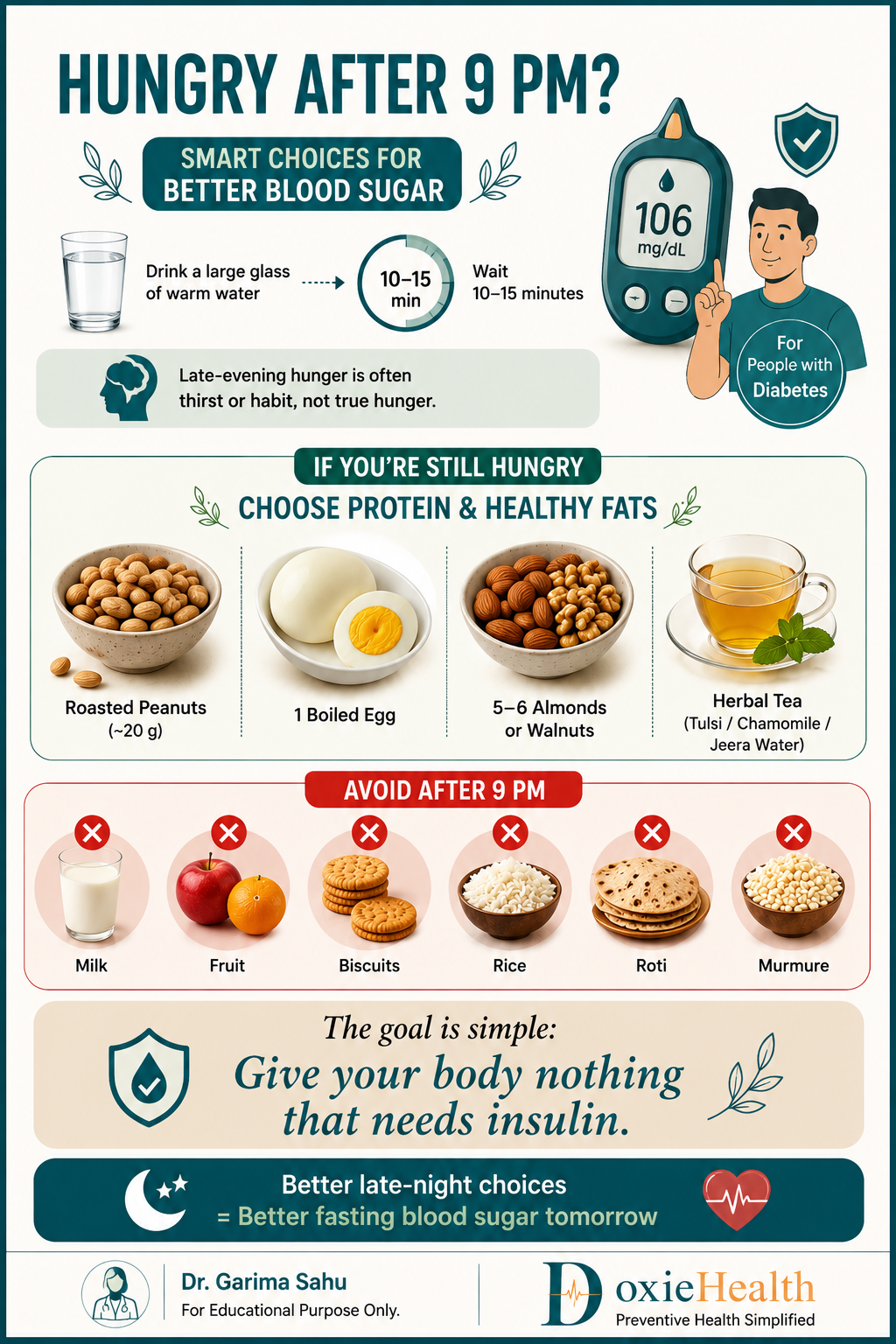
Hungry After 9 PM?
Hungry after 9 PM? Pause before you snack. Image:DoxieHealth
First, wait. Drink a large glass of warm water and wait 10–15 minutes. Late-evening hunger is often thirst or habit, not true hunger.
If genuinely hungry, choose protein and fat only, zero carbohydrates:
A small handful of roasted peanuts (~20g)
1 boiled egg
5–6 almonds or walnuts
Plain herbal tea: tulsi, chamomile, or jeera water
Do not eat after 9 PM: Milk or warm milk (12g of lactose that goes into the bloodstream at night), fruit, biscuits, roti, rice, murmure, or anything carbohydrate-based.
The goal is simple: give the body nothing that needs insulin.
Protein and fat can be processed without a significant blood sugar response. Carbs cannot.
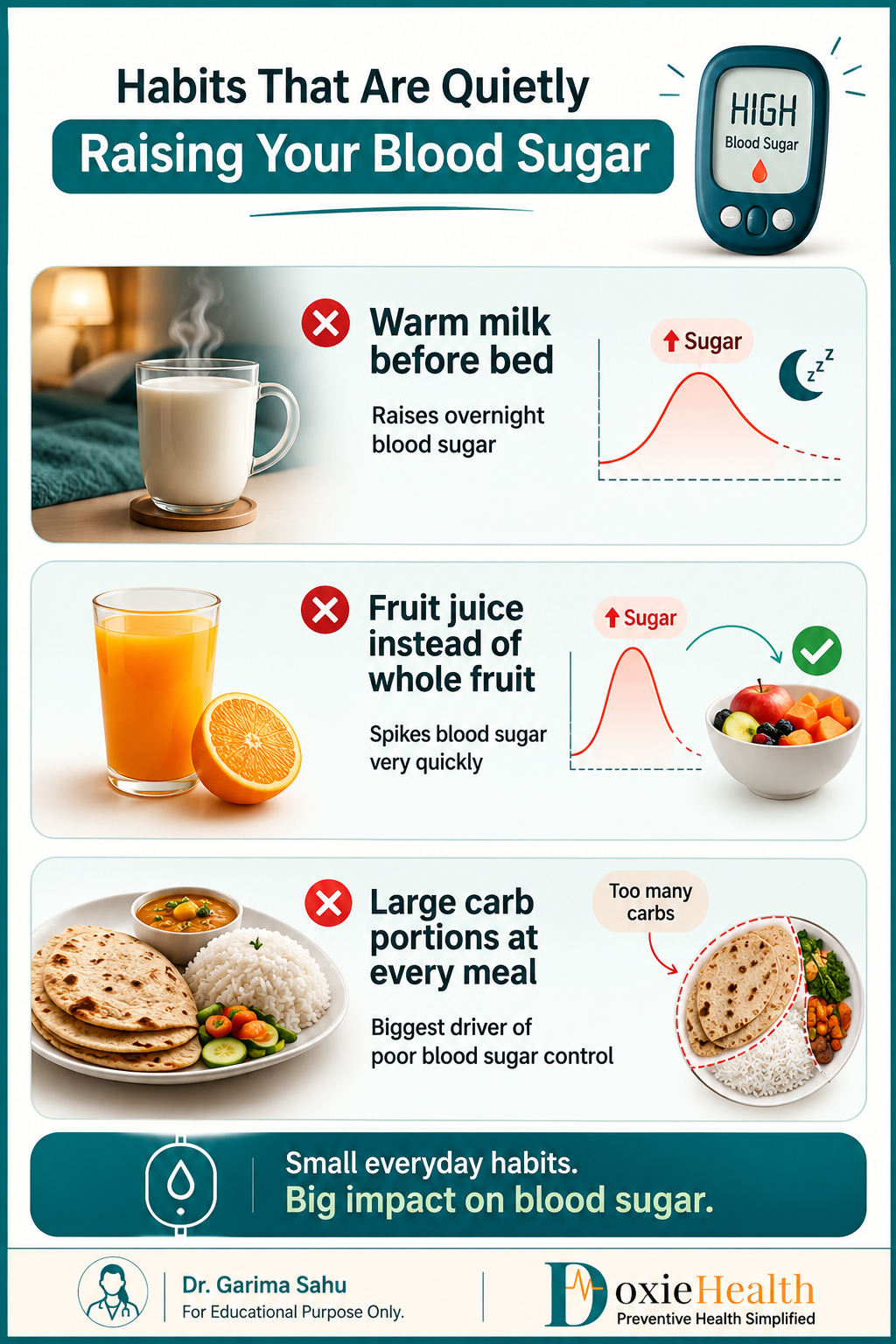
Habits That Are Quietly Raising Your Blood Sugar
Sometimes it’s not just what you eat- it’s the habits that are quietly raising your blood sugar. Image: DoxieHealth.
Warm milk before bed
Drinking a glass of warm milk at night is deeply ingrained in Indian households, and for many people with diabetes, it is silently keeping fasting glucose high.
One glass of full-fat milk contains approximately 12g of carbohydrates from lactose (milk sugar). Drunk just before sleep, when you are physically inactive, that sugar has nowhere to go. It raises overnight blood sugar and shows up as a higher fasting reading the next morning.
If you have been doing everything else right and your fasting sugar still is not coming down, this could be why. Avoid milk at bedtime entirely. A small amount of milk in your morning chai is far less of a problem.
Fruit juice instead of whole fruit
Juice removes fibre and concentrates sugar. A glass of orange juice can spike blood sugar faster than a biscuit. Eat whole fruit in small portions and never on an empty stomach.
Large carb portions at every meal
Four rotis at lunch and a full plate of rice at dinner, with minimal protein and no vegetables: this is the single most common driver of poor blood sugar control in Indian patients. No medication fully compensates for this.
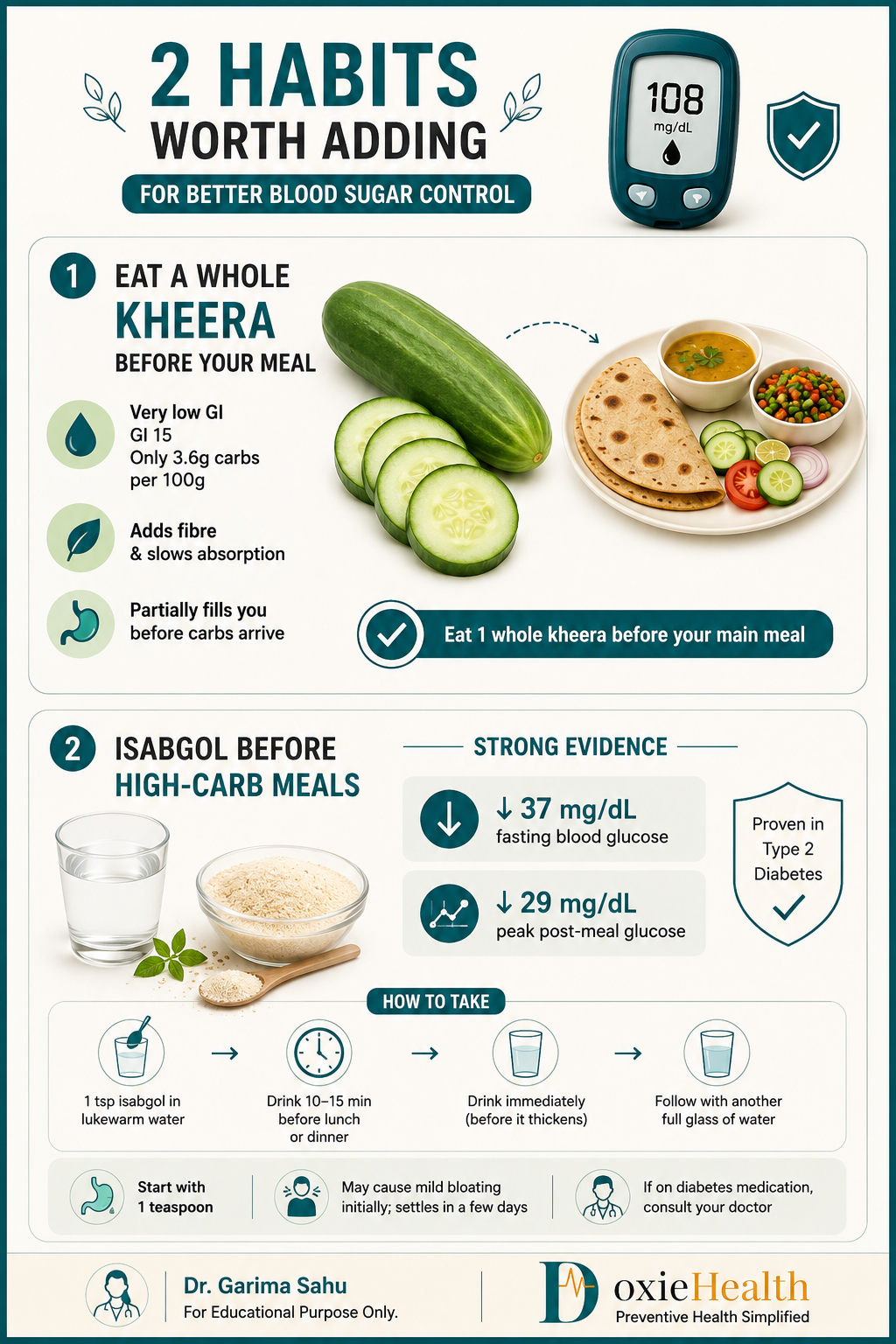
Two Habits Worth Adding
Two simple habits. A big impact on your blood sugar. Image:DoxieHealth
Eat a Whole Kheera Before Your Meal
Cucumber has a glycaemic index of just 15 and only 3.6g of carbohydrates per 100g. It causes virtually no blood sugar response. People typically eat a few cucumber slices as part of a salad, which is fine, but often too little to make a real difference.
A better habit: eat one whole kheera before sitting down to your main meal. It adds meaningful fibre volume to the stomach, slows the absorption of the meal that follows, and partially fills you before the carbohydrates arrive. No preparation needed. On days when there is no time for a salad, a whole kheera is your fibre.
Isabgol Before High-Carb Meals
The evidence here is strong. A meta-analysis published in the American Journal of Clinical Nutrition found that Isabgol taken before meals produced a mean decrease of 37 mg/dL in fasting blood glucose and 29 mg/dL in peak post-meal glucose in people with Type 2 diabetes. A separate clinical trial found that Isabgol before meals reduced maximum post-meal glucose elevation by 14% at breakfast and 20% at dinner.
How to take it: Mix 1 teaspoon of isabgol in a glass of lukewarm water. Drink it 10–15 minutes before lunch or dinner, particularly on days with a heavier carbohydrate meal. Drink immediately after mixing (before it thickens) and follow with another full glass of water.
Start with 1 teaspoon. Some people experience mild bloating in the first week as the gut adjusts; this typically settles within a few days. If you are on diabetes medication, mention isabgol to your doctor before starting, as it can enhance glucose-lowering effects.
Monitoring: Keep It Simple
HbA1c: Every 3 months until levels stabilise, then every 6 months
Fasting blood sugar: As your doctor advises, more frequently if consistently elevated
Post-meal sugar (2-hour): Check occasionally to understand how specific meals affect you
Home glucometer: Useful but not essential for everyone; discuss with your doctor
→ For a full explanation of what these numbers mean and how to read your blood sugar report, read our guide to HbA1c, fasting, and post-prandial blood sugar.
👩⚕️ Doctor’s Note
Managing Type 2 diabetes is not about perfection – it is about consistency.
One bad meal will not undo your progress, and one good week will not fix everything. What changes your HbA1c is what you do most meals, most days, over months.
Small and sustained always beats dramatic and short-lived. Start with two changes this week. Build from there.
When Should You Be Concerned?
Speak to your doctor promptly if:
Fasting sugar is consistently above 180 mg/dL despite medication
You feel dizzy, shaky, or unusually fatigued (possible hypoglycaemia — low blood sugar)
HbA1c is not improving after 3–6 months of lifestyle changes
You notice increased thirst, frequent urination, or blurred vision
The Takeaway
Type 2 diabetes is manageable. Not always easy, but manageable. The most powerful tools are on your plate and in your routine.
Choose lower-GI flours. Reduce carb portions, especially roti and rice at the same meal. Add protein to every meal: dal, paneer, eggs, chicken, lobia, rajma. Walk after eating. Add strength training twice a week. Stop the bedtime milk and the sweetened chai. Take isabgol before heavy meals. Eat a kheera before lunch. Know your HbA1c every three months.
You do not need to do all of this at once. Pick two changes this week. Just two.
→ Someone in your family is at risk but not yet diagnosed? Read our guide to preventing Type 2 diabetes.(Upcoming)
Questions to Ask Your Doctor
What is my HbA1c target: 6.5% or 7%?
Do I need to adjust my medication as I make these lifestyle changes?
Should I monitor blood sugar at home, and if so, how often?
Are there foods I should specifically avoid given my current medications?
Would you recommend a referral to a diabetes dietitian?
References
American Diabetes Association. Standards of Medical Care in Diabetes — 2024. Diabetes Care. 2024;47(Suppl 1). https://doi.org/10.2337/dc24-S005
Chaturvedi A, Sarojini G, Nirmala G, Nirmalamma N, Satyanarayana D. Glycemic index of grain amaranth, wheat and rice in NIDDM subjects. Plant Foods for Human Nutrition. 1997;50(2):171–178. https://doi.org/10.1007/BF02436036
Dziedzic B, et al. Influence of resistant starch resulting from the cooling of rice on postprandial glycemia in type 1 diabetes. Nutrition & Diabetes. 2022;12:16. https://doi.org/10.1038/s41387-022-00196-1
Gibb RD, et al. Psyllium fiber improves glycemic control proportional to loss of glycemic control. Am J Clin Nutr. 2015;102(6):1604–1614. https://doi.org/10.3945/ajcn.115.106989
Pastors JG, et al. Psyllium fiber reduces rise in postprandial glucose and insulin concentrations in patients with non-insulin-dependent diabetes. Am J Clin Nutr. 1991;53(6):1431–1435. https://doi.org/10.1093/ajcn/53.6.1431
Gujral UP, Pradeepa R, Weber MB, Narayan KM, Mohan V. Type 2 diabetes in South Asians: similarities and differences with white Caucasian and other populations. Ann N Y Acad Sci. 2013;1281(1):51–63. https://pubmed.ncbi.nlm.nih.gov/23317344/
ICMR-NIN. Dietary Guidelines for Indians. National Institute of Nutrition, 2024.
Medical Disclaimer: This article is for educational purposes only and does not constitute medical advice, diagnosis, or treatment. Always consult a qualified healthcare professional for guidance about your specific health situation.
WRITTEN & MEDICALLY REVIEWED BY
Dr. Garima Sahu, MBBS
Physician & Founder, DoxieHealth
This article is for educational purposes only and does not replace professional medical advice
One response to “How to Manage Type 2 Diabetes with Indian Diet”
Bhav
These are brilliant, thank you! I’m looking at some posters to keep at home in London for my Dad who’s 70 and Gujarati. Really love the science here, thank you


Leave a Reply